‘Digitalisation is key to many of the major challenges society faces’: Government Service Delivery 2026 Bitesize Insights

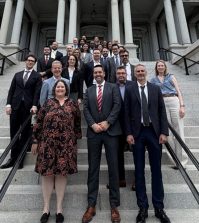
As we approach Government Service Delivery, taking place in Washington D.C. on June 10th and 11th, we asked the event’s speakers to tell us what digital transformation topics they’re most looking forward to discussing and the insights that will help drive their priorities forward in the months ahead.
Here, we pull together responses from three of the speakers – from the UK and the Netherlands – covering topics such as breaking down data siloes, how to move from pilots to system‑wide transformation, and boosting government resilience.
Government Service Delivery will bring together global digital government leaders to explore how governments can use tech-driven innovation to deliver high-quality public services. Find out more about Government Service Delivery 2026 and register to attend here
Emily Middleton is interim director general for digital transformation at the UK’s Government Digital Service.
She says that at Government Service Delivery she is “particularly looking forward to discussing how governments can turn the potential of AI and digital into real improvements in public services – not just through new tools, but by reshaping how we design and deliver services end‑to‑end”.
She notes that in the UK, the government is focused on making services simpler, more joined up and easier to use, while building the capability to deploy AI safely and at scale.
She is therefore, “keen to hear how others are tackling similar challenges, especially around moving from pilots to system‑wide transformation”.
Looking to the year ahead, she says her priority is scaling digital transformation across government with a focus on modern infrastructure, stronger capability, and better use of AI, “with a clear focus on turning that into simpler, faster, more joined‑up services for citizens”.
Mark Vermeer is director of digital government at the Netherlands’ Ministry of the Interior and Kingdom Relations.
He says that digitalisation is the key to solutions for many of the major challenges society faces, and that digitalisation helps make governments more effective, efficient and service oriented.
He also notes that as government is one of the largest consumers of digital services, “it is a driver of digital developments essential for a resilient society and a prosperous, productive and forward-looking economy”.
As such, he says he “looks forward to learning about the ambitions and discuss the ways to deal with the challenges connected to digital transformation” at Government Service Delivery.
Speaking of his priorities for the year ahead, he highlights the Netherlands Digitalisation Strategy, which was developed by central government and local and regional governments to foster a whole-of-government approach.
The strategy sets six priorities, including prioritising citizens and entrepreneurs in its digital service delivery; increasing the government’s resilience and autonomy; AI, cloud, data and digital proficiency; and a modern workspace.
“I’m interested to learn from my peers about these themes, about their experiences, their struggles and successes,” Vermeer says.
Philip Orumwense is commercial director at the UK’s Government Commercial Agency.
“I look forward to discussing how best to eliminate data silos and duplicative data collection across government and, in the process, drive transformation, modernisation, efficiency and value for the nation while enhancing transparency,” he says.
At Government Service Delivery, he intends to anchor his core discussion points on enabling capabilities such as automation, integration, real-time data access, predictive analytics, enhanced visibility and transparency, improved collaboration, and sustainability and efficiency.
“I will also discuss data integrity, governance, management, process, and systems integration drawing on case studies from the NHS Supply Chain, Amazon, P&G, Unilever and British Airways regarding their use of data to drive efficiencies,” he adds.
Further, he is keen to examine application data and AI-related technologies including areas such as agentic AI, autonomous data collection, decision intelligence, intelligent simulation and real-time insights, integration with organisation-wide data workflows and decision making, and collaboration platforms.
“My observations will focus on digitisation, as data offers transformative potential for efficiency, transparency, interoperability, value and service improvements,” he explains.
His priorities over the coming months are to break down data siloes, reduce the proliferation of data platforms, protect sensitive data through cybersecurity improvements, and work on systems resilience, and sustainability and managing environmental impacts.
“Insights and support from peers and colleagues in achieving these goals could be from peer and experiential knowledge within federated and autonomous entities that have their own delivery delegations,” he says.
The Government Service Delivery speakers quoted in this article will feature in the following sessions at the event:
Emily Middleton, interim director general, digital transformation, Government Digital Service, UK, will be speaking in the sessions ‘How technology can modernize government at all levels’, and in the fireside chat ‘Implementing AI in government’.
Mark Vermeer, director of digital government, Ministry of the Interior and Kingdom Relations, the Netherlands, will be speaking in the session ‘Data-driven delivery: How to make better use of insights in government’.
Philip Orumwense, commercial director, Government Commercial Agency, UK, will be speaking in the session ‘How to spend every dollar well: Prioritizing IT investments amid constrained budgets’.
Register for Government Service Delivery here

About Mia Hunt
Mia has been editor of globalgovernmentforum.com since 2019. She has 15 years’ experience as a journalist and editor and specialises in writing for civil and public servants worldwide, including covering sustainability policy and related issues. She has led the Global Government Women’s Network since it launched in 2023. Previously, she covered commercial property having been market reports and supplements editor at Property Week and deputy editor at Retail Destination. She graduated from Kingston University London with a first-class honours degree in journalism and was part of the team that produced The River newspaper, which won Publication of the Year at the Guardian Student Media Awards in 2010.