What is the institutional imperative – and why does it matter for evaluation in government (and everything else)?
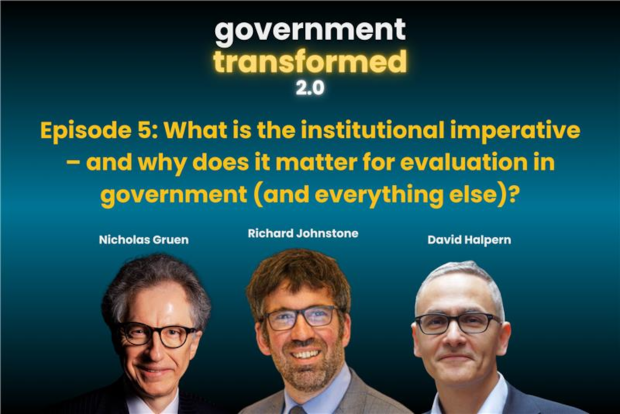
In the fifth and final episode of the Government Transformed 2.0 podcast, David Halpern rejoins Richard Johnstone and Nicholas Gruen to discuss the efficacy of evaluative processes in government, and how public servants can and should be empowered to make better evaluations of public policy.
Gruen explains the concept of the ‘institutional imperative’ by way of Warren Buffett’s ‘business imperative’, from whom he borrows the term.
“What [Buffett] says is that business managers find that they are driven to expand the business. His argument is that, as an investor and a business manager, his role is not to expand a business, but to use capital as productively as possible. And those two things are not the same in government,” Gruen, the Australian economist and government innovation thought-leader, explains.
He goes on to say that the institutional imperative often risks becoming a “preoccupying force” in government, such that it crowds out “problem-solving [and] critical thinking about how a system can improve”.
The importance of independent evaluations
In this discussion, Gruen and Halpern discuss the need for independent evaluations, the role of curiosity in driving innovation, and the potential for bottom-up meritocracy to improve government services.
Asked why he believes it is important for evaluation to reflect the end objective of a service, rather than the process itself, Halpern – president emeritus and former chief executive of the UK’s Behavioural Insights Team, now director of The Downing Battcock Institute – offers powerful examples of when evaluation has worked in government.
“We think [of] all these things we’re doing with good intent, but are they having the good impact that we hope they are? And the truth is, we often just don’t know. It’s a sort of dirty secret of government.”
Halpern’s examples include assessments of the effectiveness of getting children to stay in school longer on learning outcomes, and Gruen said that there are ways this evaluation could be undertaken.
“A good system will be working out where more schooling is better [and] where it’s not better, starting to hypothesise as to why? Where we don’t have more schooling, what might make it better, or what alternatives might exist?
“So, it’s problem solving in a forward moving organisation, and that’s what makes a great company and it’s that kind of evaluative thinking that is ultimately what we want,” he says.
Halpern expands on this. Evaluation “throws up loads of questions about what we don’t know”, and in areas like education, there has been progress in helping the teaching profession become more inquisitive.
“So be it from kids to cabinet ministers, it seems that we are able to do this. And the question becomes, can we design institutions and indeed, public service professionals need a public appetite even to ask those questions and want to answer them. Surely the answer is ‘yes’,” he says.
If you do build up this evidence base for policy, it should “definitely not to be assumed” that it will get used, he adds. “There [are] a lot of frictions and barriers in that.”
However, he says that a “glimmer of hope” is that asking these questions “actually changes your absorptive capacity, because you’ve become better at judging what constitutes good evidence”.
He concludes: “That curiosity is sort of infectious, and that’s something we’ve got to get behind.”
The series is published on GGF’s Government Transformed podcast feed. Subscribe to Government Transformed on Apple Podcasts, Spotify, or Acast, or wherever you get your podcasts.

About Jack Aldane
Jack is a British journalist, cartoonist and podcaster. He graduated from Heythrop College London in 2009 with a BA in philosophy, before living and working in China for three years as a freelance reporter. After training in financial journalism at City University from 2013 to 2014, Jack worked at Bloomberg and Thomson Reuters before moving into editing magazines on global trade and development finance. Shortly after editing opinion writing for UnHerd, he joined the independent think tank ResPublica, where he led a media campaign to change the health and safety requirements around asbestos in UK public buildings. As host and producer of The Booking Club podcast – a conversation series featuring prominent authors and commentators at their favourite restaurants – Jack continues to engage today’s most distinguished thinkers on the biggest problems pertaining to ideology and power in the 21st century. He joined Global Government Forum as its Senior Staff Writer and Community Co-ordinator in 2021.