New UK prime minister unveils plan to ‘rewire government’ on first day in post
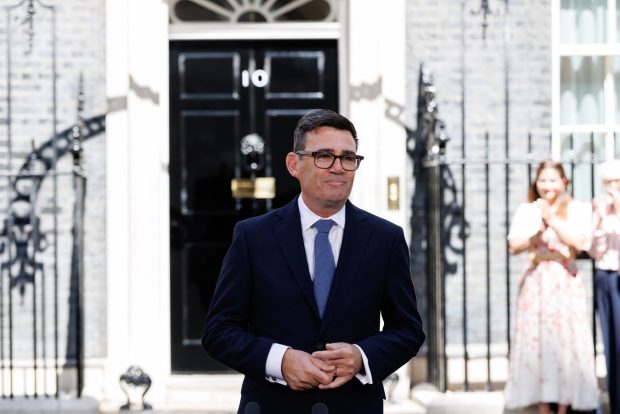
Andy Burnham, the UK’s new prime minister, has marked his first full day in office by making a number of changes to how government works, including the creation of an Office for the Prime Minister and the Cabinet to improve focus on top strategic priorities.
Following a wide-ranging reshuffle of the ministerial ranks, a number of changes to the machinery of government have been announced, with the new administration saying it was “fundamentally rewiring the state”.
These include the establishment of an Office for the Prime Minister and the Cabinet (OPMC), which will bring together the No.10 Downing Street operation and the newly created No.10 North in Manchester, which is intended to act as “the engine room of devolution and good growth in every postcode”.
A new OneGov Delivery Agency will also be created, which will manage the operational services from the Cabinet Office at arm’s length, such as the Government Recruitment Service, the government’s shared services strategy, and security vetting.
The OPMC will be led by the cabinet secretary Dame Antonia Romeo.
The machinery of government changes also set out more details of the functions of No.10 North, which will take over a number of strategic functions from elsewhere in government “to ensure places are at the very heart of government strategy”.
They include moving local economic growth and devolution strategy from the Ministry of Housing, Communities and Local Government, and local economic growth policy from the Treasury.
In a statement setting out the plans, Baroness Smith of Basildon said changing the geography of government would “deliver a stronger, more strategic centre that empowers local leaders, and acts as the engine room for driving economic growth across the whole country”.
DSIT closed and digital functions moved in government
It was also announced that the Department for Science, Innovation and Technology (DSIT) will be closed, with its functions redistributed across Whitehall, including the work of the Government Digital Service.
Most of DSIT’s functions will move to a revamped Department for Digital, Culture, Media and Sport, with responsibility for digital foundations, digital transformation, digital inclusion and skills, information resilience and online harms. Responsibility for digital identity policy will also move to DCMS, although Burnham also announced that plans for a national digital ID programme would be scrapped, with the savings used to reduce tax on electricity bills.
Additionally, OPMC will host a new AI Taskforce with the aim of driving the government’s overall strategy on AI, while the Cabinet Office will also take responsibility for AI strategy, public sector AI adoption, and house the AI Security Institute.
Other functions of DSIT will be redistributed to a beefed-up business and trade department, now rebranded as the Department for Business, Innovation, Science and Trade (DBIST).
The department will take on responsibility for the science and innovation portfolio.
Ministerial changes
As well as the machinery of government updates, Burnham made a number of changes to government ministers. Former defence secretary John Healey, who resigned criticising Burnham’s predecessor Sir Keir Starmer over defence spending, has been appointed as chancellor of the exchequer, while Louise Haigh returns to government as first secretary of state, chancellor of the Duchy of Lancaster, and minister for the Cabinet Office. Haigh will be based in the OPMC.
Jonathan Reynolds will lead the expanded business, innovation, science and trade department, while other major cabinet appointments include Angela Rayner returning to government as secretary of state for housing, communities and local government, and Yvette Cooper as health and social care secretary. Ed Miliband has been appointed as secretary of state for foreign, Commonwealth and development affairs, and has been replaced as secretary of state for energy security and net zero by Miatta Fahnbulleh.
Kanishka Narayan has been appointed as artificial intelligence minister, jointly in the Cabinet Office and the Department for Business, Innovation, Science and Trade. He will also attend Cabinet meetings.

About Richard Johnstone

Related Posts