World breaches 1.5C warming limit as climate deadline looms for governments

United Nations (UN) secretary-general António Guterres has called on governments around the world to accelerate climate action after the World Meteorological Organization (WMO) confirmed that 2024 was the warmest year on record.
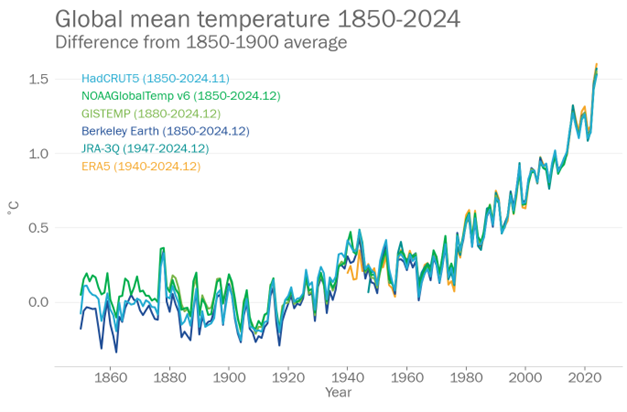
Last year the global average surface temperature was 1.55C above the 1850-1900 pre-industrial average, making it the first calendar year with a global mean temperature of more than 1.5C above this baseline. The finding is based on WMO’s consolidated analysis of datasets from leading global meteorological agencies.
“Climate history is playing out before our eyes. We’ve had not just one or two record-breaking years, but a full ten-year series,” commented Celeste Saulo, WMO secretary-general. “This has been accompanied by devastating and extreme weather, rising sea levels and melting ice, all powered by record-breaking greenhouse gas levels due to human activities.”
The finding comes ahead of the February 2025 deadline for governments to submit new climate action plans, known as Nationally Determined Contributions (NDCs), to the UN. Under the Paris Agreement, these plans are updated every five years and the approach aims to increase individual countries’ climate ambition over time.
Guterres called on governments to deliver these new national climate action plans this year “to limit long- term global temperature rise to 1.5C and support the most vulnerable to deal with devastating climate impacts”.
Read more: Climate concerns persist in 2025 but faith in government action wanes
Paris Agreement goals still in play
Despite the heat record broken in 2024, Guterres stressed that: “Individual years pushing past the 1.5-degree limit do not mean the long-term goal is shot. It means we need to fight even harder to get on track.”
“Blazing temperatures in 2024 require trail-blazing climate action in 2025,” he added. “There’s still time to avoid the worst of climate catastrophe. But leaders must act – now.”
The Paris Agreement, which was adopted by 193 countries plus the European Union and came into force in November 2016, pledged to “pursue efforts” to limit global temperature rises to 1.5C, and to keep them “well below” 2.0C above those recorded in pre-industrial times.
Saulo noted that these long-term temperature goals “are measured over decades rather than an individual year”.
“However, it is essential to recognise that every fraction of a degree of warming matters,” she said.
An international team of experts established by WMO has given an initial indication that long-term global warming as assessed in 2024 is currently about 1.3C compared to the 1850-1900 baseline.

About Sarah Wray
Sarah has over 15 years’ experience as a journalist with a specialism in the public sector and topics such as digitalisation and climate action. Sarah was formerly the editor of Cities Today and Smart Cities World, as well as a specialist video-based publication in the aerospace sector. She has also written for publications including Smart Cities Dive, Mobile Europe, Mobile World Live and Computer Weekly.

Related Posts