Women’s Network news roundup: women’s role in global food security overlooked; curbing technology-facilitated violence against women and girls; and more
Here’s our round-up of women-focused and gender equality news from the last few weeks, including think tank ODI Global’s assessment that women are central to food system resilience but that the policies, finance and institutions governing those systems are not designed to support them; the Council of Europe’s guidance on enhancing member states’ legal, institutional and regulatory responses to technology-facilitated violence; and Nigeria’s new gender equality roadmap.
Women are central to food system resilience – but policies don’t support them, warns global think tank
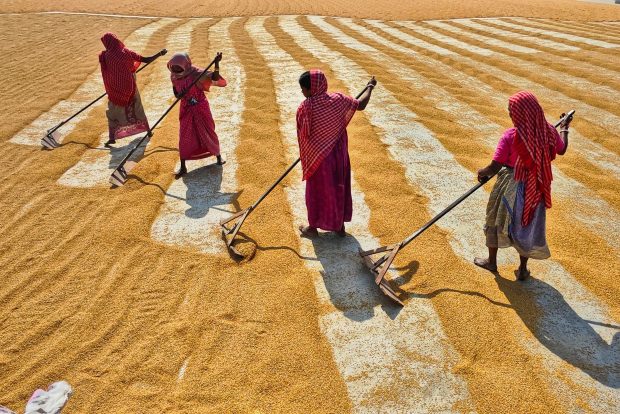
Food security, climate adaptation and agrifood system resilience largely depend on women producers – yet the policies, finance and institutions governing those systems are not designed to support them, according to a policy paper by ODI Global.
The ‘Delivering on gender equality: the missing piece in climate and food systems policy’ briefing, published in late June, examines the structural failures in climate and food systems policy and finance “that leave women in climate-vulnerable agrifood contexts, from smallholder farmers to informal market vendors and post-harvest workers, most exposed and least supported”.
The think tank emphasised that the gender provisions in climate agreements, agricultural programmes and finance instruments have not translated to “gender-responsive action”, and that investing in women’s agency and participation “is an effectiveness argument, not only an equity one”.
“Structural, rather than symbolic inclusion is what the evidence demands and what this brief proposes,” it said, adding that: “The arguments for change are established, but the political architecture to act on them is not.”
The paper identifies leverage points through which policy and finance can be redesigned, including the operationalisation of the Belém Action Mechanism and regional and national food systems architecture.
In other climate news, the UN Development Programme’s ‘Pathways to gender-responsive and inclusive NDCs’ report – published in 29 June – shows that 84 countries have integrated gender equality and social inclusion (GESI) into nationally determined contribution (NDC) planning and implementation “in a systematic and actionable way”.
The report identifies eight key entry points through which countries operationalise GESI and provides a practical framework for embedding inclusivity across the NDC cycle.
And a study by Muayad Saud Albadrani from Saudi Arabia’s Taibah University and published in the European Medical Journal, shows that adverse outcomes in women’s reproductive and sexual health – including reduced ovarian reserve, lower fertility rates, and diminished reproductive decision-making – are “significantly associated” with high temperatures due to climate change.
Join: Find out more and become a member of the Global Government Women’s Network
Council of Europe launches legal standard to curb technology-facilitated violence against women and girls
The Council of Europe has provided member states with guidance on enhancing their legal, institutional and regulatory responses to technology-facilitated violence against women and girls.
The Council said the ‘recommendation’ is the first international legal standard on this topic, and proposes “a comprehensive approach to foster an environment of accountability in which technology facilitated violence against women and girls is neither facilitated, condoned, accepted nor ignored”.
Central points of the recommendation – which was adopted by the Committee of Ministers in March and launched in June – are its victim-centred and trauma-informed approach, together with an emphasis on the engagement of multiple stakeholders.
Measures include criminalising technology-facilitated violence against women and girls and “applying effective, proportionate and dissuasive sanctions” supporting relevant data collection and research to inform evidence-based legislation, policies and monitoring; and ensuring that evidence is securely collected, handled, stored and presented, including through cross-border cooperation where needed.
It also calls for accessible justice systems, including to prevent secondary victimisation, and for a safety-by-design approach to make sure that technology companies’ products and services do not facilitate violence.
Nigeria launches gender equality roadmap
The federal government of Nigeria has launched its Gender Profile and Roadmap to Equality 2030, which it described as a “landmark national framework designed to accelerate gender equality, strengthen women’s economic empowerment, and drive inclusive national development”.
Imaan Sulaiman-Ibrahim, minister of women affairs and social development, said: “Gender equality is not a concession; it is a sound investment in the strength of our nation. When women and girls enjoy equal access to education, finance, leadership and security, families become more stable, communities become more resilient, and the economy grows.”
The gender profile and roadmap was developed by the Federal Ministry of Women Affairs and Social Development with support from the African Development Bank and UN Women, and establishes a clear implementation framework anchored on eight strategic priority areas, as well as providing the most comprehensive assessment of gender disparities ever produced in the country.
Bangladesh proposes its largest-ever gender-responsive budget
Bangladesh has proposed its largest-ever gender-responsive budget for the financial year 2026-27, allocating the equivalent of 34.8% of the national budget and 4.8% of GDP to promote women’s development and empowerment.
However, according to Bangladeshi daily newspaper The Business Standard, government spending records show a recurring pattern of underspending, with substantial portions of allocated funds remaining unused.
Experts have pointed to poor implementation and persistent structural barriers as reasons why women in the country continue to significantly lag behind men when it comes to economic participation.
Women into Leadership seminars
Global Government Forum’s Women into Leadership seminars are designed for women in the civil service who want to understand what works in terms of overcoming obstacles and achieving promotion, why it works, and how you can make it work for you.
The intention is to help you develop a far deeper understanding of the external and internal factors that can hold women back, and most importantly, what actions you can take to overcome these obstacles.
Women into Leadership – next taking place on 24 and 25 September 2026

About Mia Hunt
Mia has been editor of globalgovernmentforum.com since 2019. She has 15 years’ experience as a journalist and editor and specialises in writing for civil and public servants worldwide, including covering sustainability policy and related issues. She has led the Global Government Women’s Network since it launched in 2023. Previously, she covered commercial property having been market reports and supplements editor at Property Week and deputy editor at Retail Destination. She graduated from Kingston University London with a first-class honours degree in journalism and was part of the team that produced The River newspaper, which won Publication of the Year at the Guardian Student Media Awards in 2010.



Related Posts