Designing for democracy: lessons from Oslo’s New Government Quarter
A new government quarter in Oslo is catalysing a rethink of how different departments and agencies communicate. Here, Knut Hovland, head of design, Nordic Office of Architecture, sets out how the space is boosting collaboration
At the opening of Norway’s New Government Quarter in central Oslo, the prime minister described a small change in his working day.
“Proximity helps,” he said. “Today, I walked from my office to the minister of foreign affairs. It took one minute and forty seconds. Shorter than before.”
It is a simple observation. But it also carries a deeper meaning in this particular place.
The New Government Quarter stands where the attacks of 22 July 2011 took place, when a far‑right extremist killed eight people with a car bomb. The decision to rebuild here carried profound symbolic weight. Nearly 15 years on, it has brought government back to its historic centre while restoring continuity, reinforcing democratic values, and rebuilding trust in public institutions.
For us as the commissioned architects, this was a once-in-a-generation opportunity. The task was not only to repair a part of the city, but to rethink how government works. The decision to bring together the majority of ministries on a single site became central to that ambition. It worked at two levels: reshaping Oslo’s urban fabric and transforming the everyday interactions and decision-making in government.
The prime minister described the project as an “urban repair”. That description captures both the physical and institutional ambition.
Rethinking how government works
Many governments seek to foster collaboration between ministries, improve efficiency, and shift working cultures toward more open and joined‑up ways of operating. Estate rationalisation, new headquarters, and hybrid working policies are often treated as purely technical or financial exercises. In Oslo, we approached a similar challenge from a different starting point. What if workplace design was seen as a tool of governing rather than simply a container for it?
The New Government Quarter brings together more than 4,000 civil servants across multiple ministries, including the Office of the Prime Minister, on a historic city‑centre site. Rather than focusing on desks and floor area, we began by addressing what many civil services are now grappling with: how should government work in the 21st century, when most of the hardest problems cross departmental boundaries?
Climate policy intersects with energy, transport and finance. Digitalisation affects security, welfare delivery and regulation. These are shared questions that require shared responses. In most countries, organisational structures acknowledge this complexity, yet their physical environments still reinforce separation. Buildings are spread across cities, access is controlled, and everyday encounters between departments are rare.
Designing for collaboration
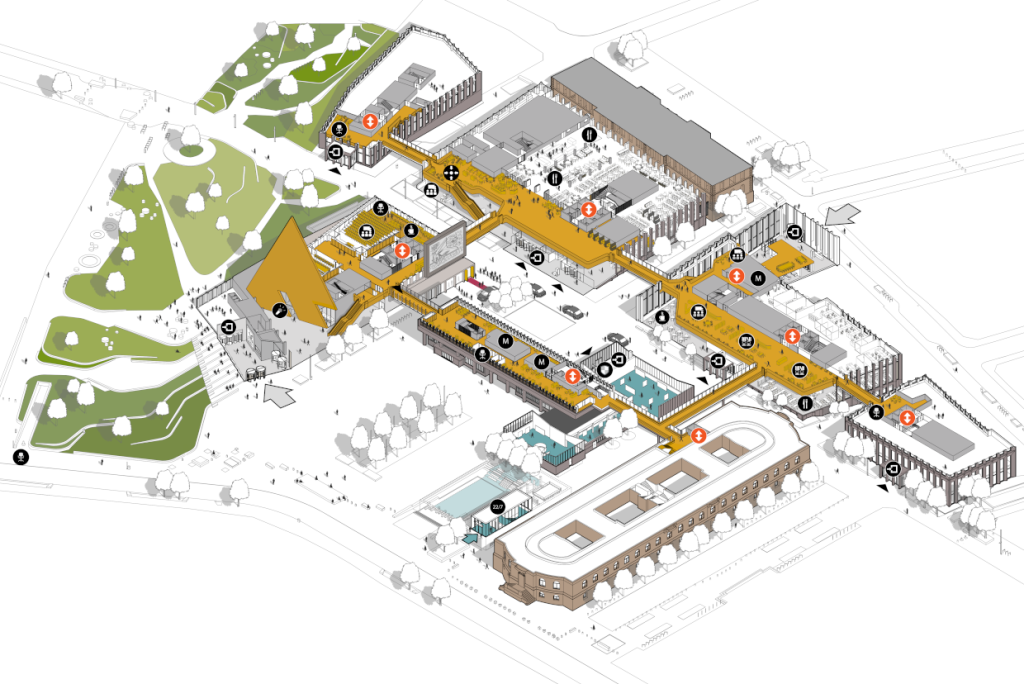
In Oslo, our answer is expressed through relationships between buildings, people and movement. A defining element is the Collaboration District, a continuous shared level that connects Norway’s ministries across seven buildings. It is the main route people use to move between departments. Shared services, meeting spaces, and informal work areas are placed along this level, meaning that everyday movement becomes visible and social. Encounters occur as part of daily routines. Conversations begin earlier. Issues are understood in a broader context.
This is what we mean when we describe the quarter as a “decision‑making machine”. The architecture supports the flow of knowledge across institutional boundaries and strengthens familiarity between people who work on related challenges. Seeing colleagues regularly makes exchange quicker and more informal. Over time, this builds trust and shared understanding that carries into formal decision‑making.
One civil servant described looking forward to sending fewer emails after the move, simply because it would be easier to speak to colleagues in person. This may sound modest, however anyone who works in government knows how much time and energy can be lost when communication becomes fragmented.
The prime minister put it this way: “Shared expertise and trust between people create better decisions. Cross‑disciplinary collaboration is at the heart of our democracy.”
Infrastructure for democracy
The prime minister described the New Government Quarter as “infrastructure, not for roads and cables, but for democracy”. Its value builds over time through faster coordination, reduced duplication and clearer communication.
Questions of cost and security are unavoidable in large civic projects, and this one is no exception. Bringing government together in a central location requires significant investment, as well as careful attention to safety and security. But not coming together would have cost more in the long term. The efficiency of interaction, the clarity of communication and the strength of coordination all contribute to the effectiveness of the state.
Opening government to the city
The New Government Quarter also restores a fundamental relationship between governing institutions and the city they serve. In the aftermath of 22 July 2011, Norway’s prime minister declared: “Our answer is more democracy, more openness, more humanity. But never naivety.” That statement became the guiding brief at the urban scale – and it is reflected in every design decision that followed.
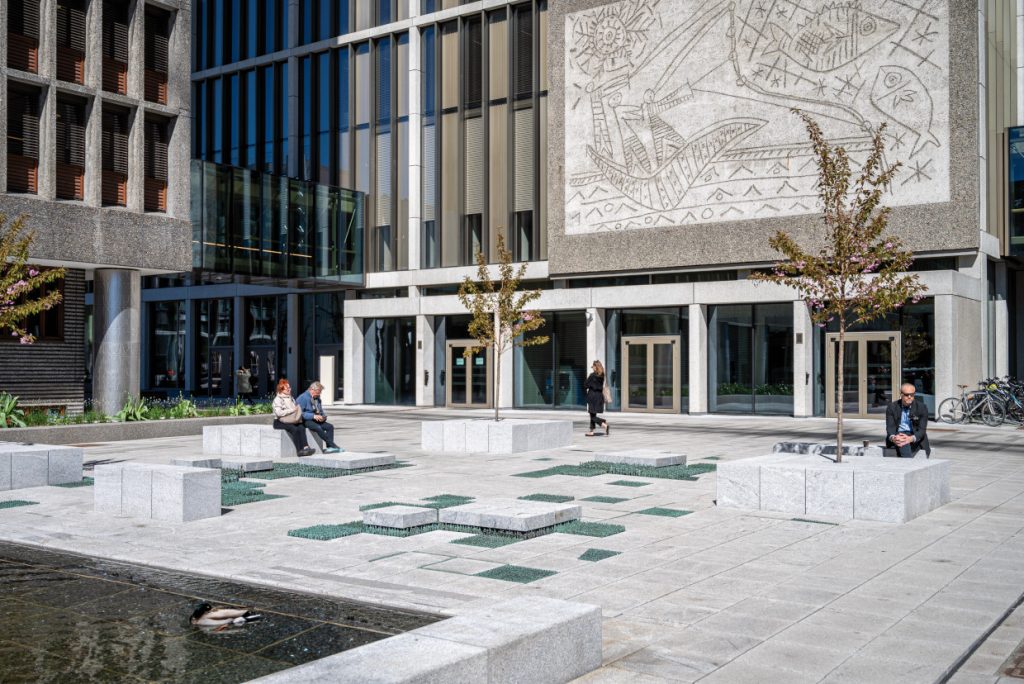
Rather than erecting a single monolithic institution that closes off public space, the quarter comprises seven distinct buildings that each engage with the surrounding city – while together forming one coherent home for the ministries. New routes for walking and cycling pass through the site. Public squares and ground-level spaces remain openly accessible. Local materials – timber and stone – along with integrated artworks signal that government is woven into the fabric of everyday urban life.
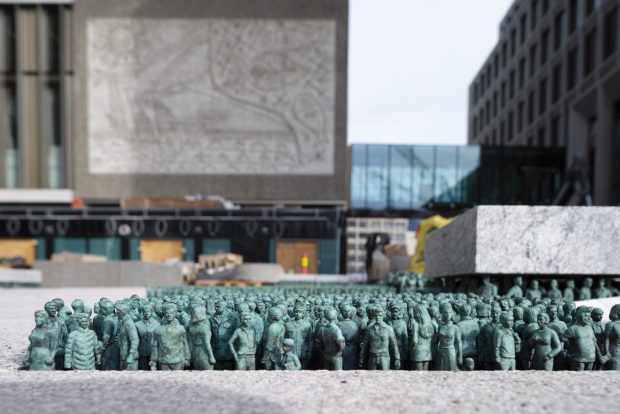
Two artworks make this intention particularly tangible. Do Ho Suh’s Grass Roots Square consists of 50,000 small bronze figures with a green patina, representing societal unity. Jumana Manna’s large mosaic in the main square is assembled from stone offcuts collected from municipalities across the country – embedding a sense of collective national ownership into the daily experience of both civil servants and citizens.
This relationship between institution and city is essential. Openness in space supports transparency in governance. In that sense, the New Government Quarter is more than a workplace – it is an investment in democracy itself, built not just for the government of today, but for the city and its people long into the future.
What can other governments learn from Oslo?
Three lessons stand out.
First, start with behavior. Before designing spaces, be clear about how people need to work together. Collaboration and problem‑solving depend on visibility and ease of access. Layouts that encourage chance encounters and shorten distances can change working patterns without rewriting formal structures.
Second, prioritise proximity and shared ground. Distance affects how often colleagues interact and understand each other’s work. Shared circulation routes and common spaces place departments on equal footing. A short walk can replace a formal process, saving time and building familiarity.
Third, align space and culture. New environments introduce new habits. When design supports openness and adaptability, it reinforces broader cultural shifts toward collaboration. This only works if leadership encourages people to use spaces as intended and allows working practices to evolve over time.
Governments will continue to face challenges that cut across portfolios and demand coordinated responses. The answer is not more process, but better conditions for people to think and act together. Transparency, proximity, and well-placed meeting points enable quick, informal dialogue across ministries. When the right people can find each other easily, decisions become faster, sharper, and more joined-up. Do our buildings make that possible? In Oslo, the answer is yes.

About Knut Hovland
Knut Hovland, head of design, Nordic Office of Architecture