Estonia set to be first country to create digital identities for AI agents
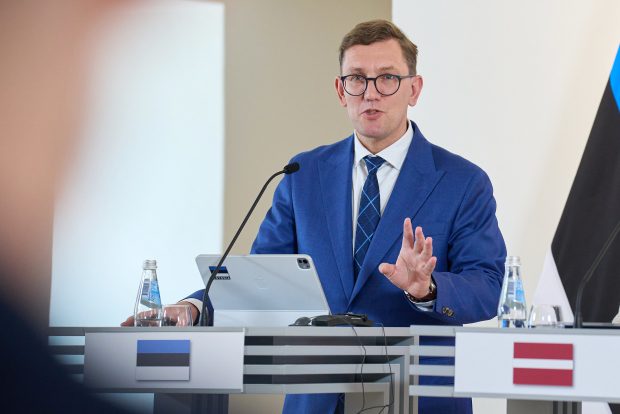
The government plans to develop ‘AI ID codes’ to enable AI agents to act on behalf of people and organisations ‘in a manner that is both verifiable and auditable’
The government of Estonia has announced that it plans to create digital identities for AI agents to enable it to track decisions made by artificial intelligence systems, in what is thought to be a world first.
Estonia’s Eesti.ai Advisory Board agreed on 17 June that the country would create “AI ID codes” for AI agents so that the government can trace and verify the actions they take on behalf of people and organisations.
AI agents are designed to make decisions and execute a series of tasks – based on predefined rules and predetermined goals – with little or no human intervention.
The government – which is regularly cited as the most digitally advanced in the world – said the decision to create AI ID codes would mean that AI could act on behalf of people and organisations “within clearly defined limits and in a manner that is both verifiable and auditable”.
It said this would “help to prevent situations where individuals or organisations are required to grant AI assistants access to all of their rights, services and data”.
Kristen Michal, the country’s prime minister, said: “In the future, AI will increasingly carry out digital tasks on our behalf, compiling reports, preparing declarations or interacting with information systems. To that end, it must be clear who is acting on whose behalf with what rights, and who is ultimately responsible.”
He emphasised that Estonia’s digital state “was built on trust” and that digital identities, the X-road data exchange platform and digital signatures had helped to make the country “faster, simpler and more secure”.
“Now that we find ourselves in the age of AI agents, we are faced with the same question: how can we use that technology in a way that makes life easier but without losing control and accountability? If we act quickly, and smartly, Estonia will become the first country in the world to create official digital identities for AI agents.”
Find out more about AI agents. In the episode of the Government Transformed podcast embedded below, Luukas Ilves, Estonia’s former undersecretary for digital and government chief information officer and Manuel Kilian, the founding managing director of the Global Government Technology Centre, discuss how AI agents and agentic AI can revamp how government works.
Bid to be the world’s most AI-savvy nation
Eesti.ai is a national initiative – developed in cooperation with international experts and entrepreneurs – that aims to increase the value of Estonian people’s work and the economy through the systematic application of artificial intelligence.
At the body’s latest advisory board meeting, board members were also given an overview of AI programmes and projects that are either underway or in the pipeline.
One of these is the ‘Most AI-Savvy Nation’ initiative, which was launched earlier this year and aims to upskill the population in artificial intelligence.
A pilot which ran from April to June 2026 saw approximately 1,200 people attend 35 practical AI workshops across six cities, and the next phase aims to have 10,000 people participate in a workshop by the end of the year and to launch a wider network of trainers, partners and short courses, the government said.
The board were also given an update on the LLM Leaderboard of the Institute of the Estonian Language (IEL). The leaderboard assesses the quality of large language models in Estonian, their knowledge of Estonian culture and their resistance to propaganda.
The quality of Estonian-language AI models is inconsistent, and simpler and cheaper models often perform less well in Estonian than in other languages, according to the IEL, which noted that the “use of unsuitable models could heighten the risk of misleading information being disseminated”.
It said that Estonia must play a part in the development of Estonian-language AI, “primarily by ensuring the availability of high-quality pre- and post-training data”.
It added that “it is important that the public sector, educational institutions, businesses and individuals are able to make informed choices about which models to use in which situations, and that Estonian language and culture are not left to chance in the development of AI”.
Board members also heard about opportunities for testing “physical AI and dual-use technologies”, including ‘Merepesa’, which aims to establish a testing environment in the Gulf of Finland and the wider Baltic Sea region for testing air and water drones.
The government said that organising open-sea trials “is a costly and time-consuming undertaking… which involves a lot of red tape” and that Merepesa offered the opportunity to test unmanned systems in the air, on the water and underwater simultaneously.
“Since the Baltic Sea region offers few internationally accessible open-sea testing facilities, such a solution could give Estonia a regional advantage in the development of drones, the defence industry and autonomous systems,” the government explained.
Read more: Ukraine ‘deepens cooperation’ with Estonia in digital governance and cybersecurity

About Jack Aldane
Jack is a British journalist, cartoonist and podcaster. He graduated from Heythrop College London in 2009 with a BA in philosophy, before living and working in China for three years as a freelance reporter. After training in financial journalism at City University from 2013 to 2014, Jack worked at Bloomberg and Thomson Reuters before moving into editing magazines on global trade and development finance. Shortly after editing opinion writing for UnHerd, he joined the independent think tank ResPublica, where he led a media campaign to change the health and safety requirements around asbestos in UK public buildings. As host and producer of The Booking Club podcast – a conversation series featuring prominent authors and commentators at their favourite restaurants – Jack continues to engage today’s most distinguished thinkers on the biggest problems pertaining to ideology and power in the 21st century. He joined Global Government Forum as its Senior Staff Writer and Community Co-ordinator in 2021.