New Zealand government needs a digital ‘reset’, rapid review finds

The review finds that digital investment across government is fragmented and that prioritisation of digital projects is weak, and provides recommendations to fix these and other issues
New Zealand’s system for digital delivery across government is not working effectively, a rapid review initiated by public service commissioner Sir Brian Roche has found.
The review was launched to assess what works and what needs to change to ensure digital delivers for the government and citizens. It came after the New Zealand government took steps to centralise and streamline digital investment, including establishing the Public Service and Digitising Government portfolio and transferring the government chief digital officer function and the Government Digital Delivery Agency (GDDA) to the public service commissioner.
‘Weak central digital function’
The review found that despite an annual investment of NZ$42m (US$24m) in a central digital function, digital investment across government is fragmented, with duplication and limited coordination, while prioritisation of digital projects is not strong enough at a system level.
It also warned that New Zealand lacks “ambition or a coherent strategy” for government AI and is quickly falling behind international peers.
The review states that: “A combination of factors have contributed to major performance issues in recent years including a system that is poorly informed as to the nature and value of tech investment across the system; has poor co-ordination to resolve the inevitable conflicts and trade-offs in delivering complex tech projects; has a weak central digital function that focuses on the functional rather than the strategic and is not seen as playing its critical role as the expert support needed by the agencies – all at a time of fiscal constraint, greater public expectations and remarkable change in foundational tech capabilities such as AI.”
Further, it said that engagement with technology providers is inconsistent and does not support long-term partnerships or co-investment.
The process was led by Adrian Littlewood, former chief executive of Auckland Airport, Justin Gray, former managing director of Datacom, and Matt Crockett, who has led large-scale organisational transformation and performance improvement programmes.
Recommendations
Roche said: “This review gives us a clear picture of what’s working and what’s not.
“I commissioned this work to assess digital delivery across government. It’s not about individuals – it’s about how the system is set up, and how we can make it work better.
“We need the Government Digital Delivery Agency to be fit for purpose because it has an integral role in the work we are doing to transform the Public Service, and the broader service delivery model.”
The reviewers recommend three “parallel tracks” to reset the digital approach.
The first is to reset prioritisation “so that scarce resources flow to the highest-impact projects”.
Second is to reposition the GDDA as “the system’s highly capable central strategist, technical authority, and commercial broker” – this means guiding the system while holding agencies accountable for delivering complex projects.
Closing digital capability gaps
The third proposal is to “reform the wider system to remove the structural barriers that constrain delivery performance and undermine all-of-government outcomes”. This would include standardising the technology leadership and accountability model, closing digital capability gaps across agencies, and resetting incentives.
It would also mean reviewing and removing any “overlapping or inconsistent digital mandates” and monitoring change to ensure there is no reversion to the previous siloed approach.
The reviewers propose confirming and enforcing consistent reporting of technology cost and performance outcomes and benefits across government agencies and pursuing legislative or policy change where needed ”to unlock foundational projects that will deliver greatest productivity”. ‘Bundled consent’ options for citizen data is given as an example.
The review acknowledged various international models for digitising government and that while none are a perfect fit for New Zealand, Australia’s Digital Transformation Agency is most relevant.
Roche will consider the findings of the review before making decisions on a way forward.
Read more: Major study with 12 UK permanent secretaries reveals key enablers to ‘rewiring the state’
Future-proofing government digital capability
The review aligns with several findings of a recent Global Government Forum study which found that governments need to move from a reactive, siloed approach to managing digital capability in a system-wide way.
The Future-proofing government digital capability study, led by Kevin Cunnington, executive advisor at GGF and former director general of the UK Government Digital Service, explores how government organisations can ensure they have the right capability in place to deliver on their digital visions.
Based on interviews and a roundtable with over 20 digital leaders from around the world, the report identifies six common foundations that underpin digital capability across governments, and how to make sure these foundations are resilient in a fast-changing environment.
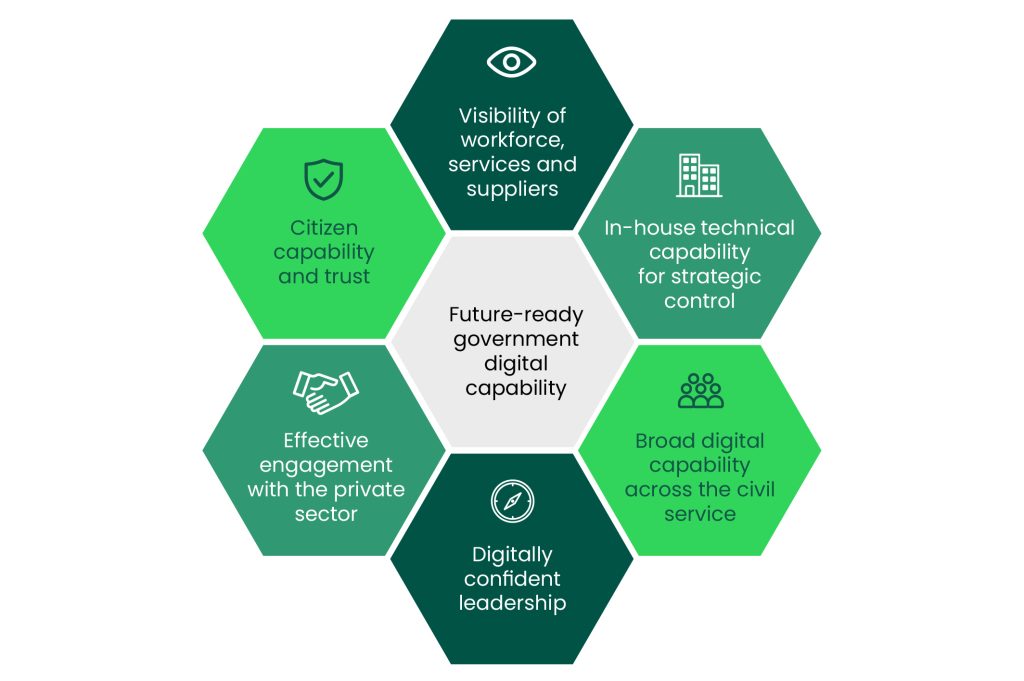
Cunnington writes in the foreword: “The ability to meet today’s expectations and capitalise on tomorrow’s opportunities depends on capability – the right people, skills and partners to deliver. Governments need a clear understanding of their digital service priorities; strong in-house technical capability to retain control; a workforce that is confident in using digital tools and approaches; and a strategic approach to engaging and shaping the supplier ecosystem. They also need to ensure citizens are well-equipped to adopt digital services.”
He added: “Achieving better capability depends on answering the questions: What does ‘good’ look like? And how do we measure it? Through Global Government Forum’s advisory and training work with governments, we see first-hand how difficult it remains to answer these questions in a consistent, system-wide way. I believe that this needs to change, and that governments need to start treating capability as something they actively design and measure.”
Read more: Korea, Australia and Portugal ranked top for digital government

About Sarah Wray
Sarah has over 15 years’ experience as a journalist with a specialism in the public sector and topics such as digitalisation and climate action. Sarah was formerly the editor of Cities Today and Smart Cities World, as well as a specialist video-based publication in the aerospace sector. She has also written for publications including Smart Cities Dive, Mobile Europe, Mobile World Live and Computer Weekly.

Related Posts