Leadership – the critical digital lever for governments

The fourth in a series of extracts from Global Government Forum’s new study on future-proofing digital capability examines how a strong technical workforce alone is not enough – leadership is increasingly critical to digital delivery
The Future-proofing government digital capability study, led by Kevin Cunnington, executive advisor at GGF and former director general of the UK Government Digital Service, explores how government organisations can ensure they have the right capability in place to deliver on their digital visions.
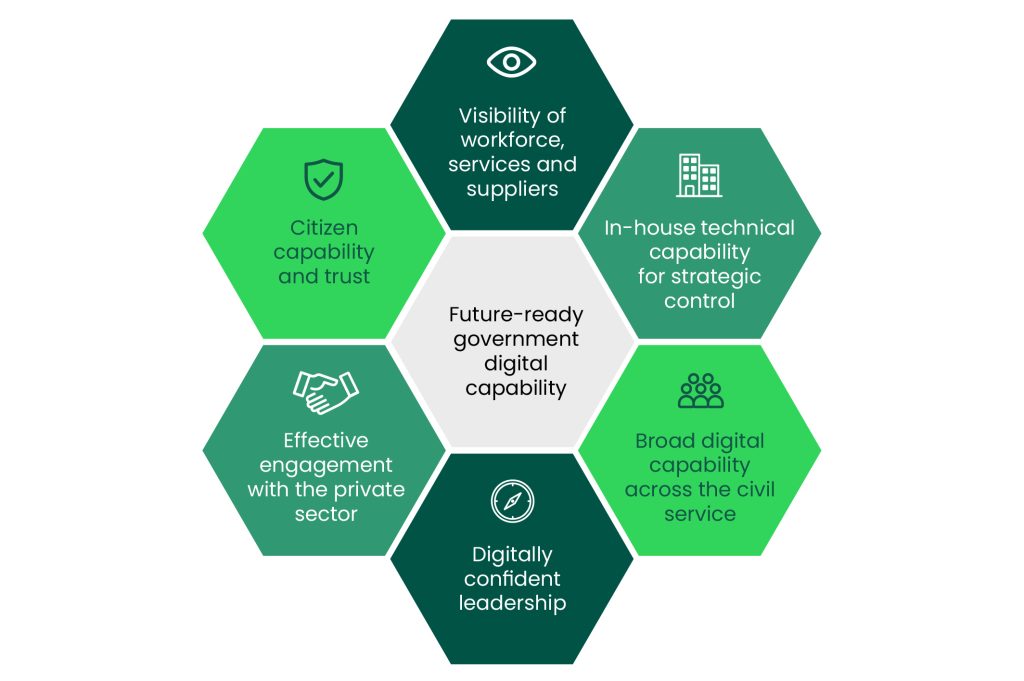
Based on interviews and a roundtable with over 20 digital leaders from around the world, including the UK, the US, Canada, Singapore, Australia and New Zealand, the report identifies six common foundations that underpin digital capability across governments, and how to make sure these foundations are resilient in a fast-changing environment.
Cunnington writes in the foreword: “The ability to meet today’s expectations and capitalise on tomorrow’s opportunities depends on capability – the right people, skills and partners to deliver. Governments need a clear understanding of their digital service priorities; strong in-house technical capability to retain control; a workforce that is confident in using digital tools and approaches; and a strategic approach to engaging and shaping the supplier ecosystem. They also need to ensure citizens are well-equipped to adopt digital services.”
This extract explores the fourth pillar: Digitally confident leadership.
Download the report: Future-proofing government digital capability: Six foundations for success
Leadership can ‘change the tide’
Across interviews, digital capability among senior leaders emerged as a critical component of a future-ready civil service and is becoming a growing priority.
As one interviewee put it: “All public service leaders need to be digital leaders.”
Another emphasised the scale of influence leadership has over outcomes: “If we can get all leaders to be digital leaders, then we may be able to change the tide,” they said.
A recurring theme across interviews was that many senior civil service leaders and ministers do not yet have a sufficient understanding of digital and AI. This has been a consistent finding across Global Government Forum’s research studies.
This is not simply a knowledge gap, but a problem of expectations and decision-making. Several interviewees described unrealistic assumptions about what digital technology can deliver – particularly in relation to cost savings and speed of transformation.
One described this as “the AI magic wand phenomenon” or “AI FOMO” – fear of missing out.
Others pointed to a broader lack of understanding about the nature of digital investment: “You can’t just go from where you are to being an AI organisation, and they’re not prepared to invest because of the fiscal situation. So, we’re in a difficult pathway because of that.”
Leadership gaps are reinforced by processes that separate digital expertise from key decisions. One interviewee described a “baffling” scenario in which chief financial officers approve major technology investments while digital leaders are left out.
Read more: Why governments must ‘grab the nettle’ on digital capability
Leadership capability as a priority area
In response, many governments are placing increasing emphasis on developing digital understanding among senior leaders.
This includes targeted programmes for permanent secretaries, agency heads and ministers, covering topics such as digital delivery, legacy technology, cybersecurity and the practical applications of AI.
As one interviewee explained, the goal is not to turn leaders into technical experts, but “to give them the language and comprehension of all these important decisions they will be making in their capacity as senior leaders”.
Ukraine, for instance, is focused on building a pipeline of leaders able to drive digital reform through its national CDTO Campus initiative designed to train chief digital transformation officers and their teams. The programme combines technical knowledge, leadership skills and strategic capability, and is open both to public servants and professionals transitioning into government.
Tailoring training for leaders
Interviewees agreed that traditional training formats are not effective for a senior cohort. These leaders often have limited time and may be reluctant to engage if they feel less knowledgeable than others.
“We know that leaders are scared of their own digital skillset,” one interviewee said, explaining that acknowledging a gap risks leaving them feeling “exposed”.
As a result, more tailored approaches have emerged. These include peer-based learning environments where leaders can engage alongside colleagues at a similar level, as well as short, intensive, discussion-led sessions.
One example combined expert input from academics and the private sector with facilitated discussion. The interviewee said: “If you get them in a room with their peers, where they’re going along at a similar pace, and you’ve organised the content in a very empathetic way, I’ve seen it work very well. The feedback was excellent.”
Others have developed digital awareness courses for senior leaders, focusing on “where the guardrails are, but also what some of the positive use cases are likely to be”. To accommodate leaders’ busy schedules, interviewees report the best results with fast-paced, conversational in-person sessions.
Turning strategy into delivery: Find out more about Global Government Forum’s training and advisory services
Driving adoption
In some cases, participation has been driven by strong top-down sponsorship, helping to normalise digital as a core leadership responsibility.
However, some interviewees suggested that voluntary approaches may not be sufficient, and that more formal expectations or requirements for leadership capability may be needed given the importance of the role.
Cabinet ministers and senior public service leaders were among the first groups to receive digital training through Singapore’s new Institute of Digital Government.
“Leaders set the conditions. When they understand the digital landscape, they can guide change confidently and ask their teams the right questions,” said minister of state for digital development and information, Jasmin Lau.
The UK’s Roadmap for Modern Digital Government details how assessment of all newly appointed directors and director generals will include digital and data skills and behaviours, with digital expectations stated in job descriptions and reflected in performance objectives. The Cabinet Office is also leading AI immersion workshops for the Civil Service Leadership Group, which is made up of 300 senior civil servants. Further, a cross-government leadership development programme has been established, covering topics such as strategic leadership, commercial acumen and system-level thinking.
Leadership: The critical digital lever
These findings suggest that leadership is not simply one component of digital capability, but the critical lever through which other capabilities are enabled or constrained.
Workforce skills, recruitment reforms, training programmes and supplier strategies all depend on leadership decisions. Without leadership understanding and support, these initiatives struggle to scale or sustain impact.
However, where leaders treat digital as a core responsibility, capability can develop more rapidly and consistently.
Building the foundations for future-ready capability: Digitally confident leadership
- Digital capability as a core leadership expectation. Digital and data understanding will need to be treated as a fundamental requirement for senior roles, reflected in recruitment, performance management and career progression.
- Leadership capability focused on decision-making, not technical depth. The priority is not to create technical experts, but leaders who can make informed decisions about investment, risk and delivery in a digital environment.
- Learning designed for confidence and application. Effective approaches will prioritise peer learning, practical discussion and real-world use cases, helping leaders build confidence and apply digital thinking in practice.
- Leading by example. When senior leaders actively engage with digital tools, participate in training and demonstrate curiosity about new technologies, it signals that digital capability is a core expectation, helping to shift culture across the organisation.
GGF will now take the collaborative opportunities identified in this report forward – if you’d like to be involved, get in touch by emailing [email protected] so we can structure the work to be as useful as possible.

Participants in the study were as follows (job titles reflect those at the time of interview/roundtable participation):
- Dr Subho Banerjee, deputy commissioner, head of the Australian Public Service Academy and capability, Australian Public Service Commission
- Gregory Barbaccia, federal chief information officer, Office of Management and Budget, United States
- Thomas Beautyman, deputy director of government digital capability, Department of Science, Innovation and Technology, United Kingdom
- Dominic Chan, assistant chief executive, product, and chief information officer, GovTech Singapore
- Marie-Chantal Girard, president, Public Service Commission, Canada
- Shafiqa Dawood, chief digital and technology officer, Department for Education, United Kingdom
- Wolfgang Ebner, federal chief digital officer, Austria
- Richard Gevers, head of service design and delivery, Digital Services Unit, South Africa
- Luukas Ilves, former chief information officer and undersecretary for digital transformation, Government of Estonia, and advisor to the deputy prime minister and minister of digital transformation, Ukraine
- Valeriya Ionan, advisor to the deputy prime minister of Ukraine on innovation, digitalisation and global partnership and former deputy minister of digital transformation, Ukraine
- Birna Íris Jónsdóttir, CEO, Digital Iceland, Iceland
- Paul James, government chief digital officer, New Zealand
- Romina Kostani, deputy general director of the National Agency of Information Society, Albania
- Chris Leck, group chief technology officer, Public Sector Science & Technology Policy & Plans Office, Prime Minister’s Office, Singapore
- Barry Lowry, government chief information officer, Ireland
- Lauri Luht, government chief information officer, Estonia
- Dominic Rochon, government chief information officer, Canada
- Haseley Straughn, digital development policy coordinator, Ministry of Industry, Innovation, Science and Technology, Barbados
- Jaanus Vant, AI and data strategy coordinator, Ministry of Economic Affairs and Communications and Ministry of Justice, Estonia
- Paul Wagner, chief executive officer, Canadian Digital Service, Canada
- Vicky Wang, senior director, digital workforce transformation, Smart Nation, Singapore
- Claire Wraith, head of strategic workforce and transformation, Government Digital Service, United Kingdom

About Sarah Wray
Sarah has over 15 years’ experience as a journalist with a specialism in the public sector and topics such as digitalisation and climate action. Sarah was formerly the editor of Cities Today and Smart Cities World, as well as a specialist video-based publication in the aerospace sector. She has also written for publications including Smart Cities Dive, Mobile Europe, Mobile World Live and Computer Weekly.

Related Posts