Evergreen arguments: persuading the public on sustainability
At the 2022 Global Government Summit, civil service leaders from around the world explored one of their greatest challenges: how to win public support for the tough decisions required to avert climate change. Adam Branson reports
“So many different jurisdictions, different contexts, and yet everyone’s grappling with very similar issues – and I think they’re becoming even more similar,” said Hannah Cameron. “With the pandemic and climate change among the key things that everybody is putting at the top of their priority lists, we’ve got convergence around everybody wanting to solve the same kind of problems, whereas maybe in the past there were different political priorities. So that provides a real opportunity for us all to work together, and to look for interesting lessons and commonalities.”

Cameron, the Deputy Commissioner of New Zealand’s Public Service Commission, was “inspired and hopeful” about the sense of common purpose she’d encountered at the Global Government Summit: an annual event that brought together top civil service leaders from 14 countries for two days of informal, frank discussions. Held in January – before Russia’s invasion of Ukraine diverted the world’s attention – the participants agreed that many governments have retained their focus on tackling climate change and promoting environmental sustainability even through the pandemic.
That was certainly the case in Singapore, noted Albert Chua, Permanent Secretary of the city-state’s Ministry of Sustainability and the Environment. “Right in the middle of tackling the COVID-19 crisis, we complemented our climate pledges by launching the Singapore Green Plan 2030,” he commented. “This was a very significant move, because the government decided that it needed to also invest time and energy to launch the whole nation plan which charts Singapore’s way forward when it comes to sustainable development and climate action.”
Persuading the public
While governments increasingly recognise the need to address climate change, however, they must bring their populations with them. Alex Chisholm, the UK civil services’ Chief Operating Officer, argued that the UK has a strong track record on cutting carbon emissions: it committed to net zero by 2050 two years ago, and now generates more than half of its power from renewables. But the public’s willingness to make sacrifices in pursuit of net zero, he suggested, remains untested.

“Most of the progress we’ve made to date has been through government action and business action,” he said. “It hasn’t required massive changes by consumers. In the power sector, for example, what’s happened upstream has required huge investments, big changes to the regulation and massive infrastructure. But it doesn’t make much difference to citizens. It’s a business to business or government to business activity.”
That, Chisholm warned, will have to change: only with public behaviour change, maintained over the long term, will the UK be able to realise its net zero goal. “We think we’re going to have a much higher level of consumer and citizen involvement for the next phase, and we’ve got to be able to sustain that,” he said. “We tend to think in electoral cycles of four or five years, but this needs to be about decades.”
Investing for the future
This struck a chord with Leo Yip, Singapore’s Head of Civil Service, who pointed out that on climate change, “management of future risks requires today’s sacrifices.” In order to win support for the investments required, he said, governments must “mobilise and galvanise the public, and say: ‘We’re doing something today to prevent sea levels rising, because your grandchildren will inherit this’.”

In the UK, commented Chisholm, the government’s efforts to “enthuse and engage” the public have included bidding to host the COP26 climate change conference held in Glasgow late last year. “We felt that people need to see this is part of the global effort and that every country is participating, because if they didn’t see that then to the extent it requires investments and sacrifices, people might say: ‘Why would I do that, given the UK is now responsible for less than 1% of carbon emissions?’” he said. “We wanted to show that by being a good example, we can expect that from other people.”
Singapore’s government also recognises the crucial importance of multilateral collaboration. “In the case of Singapore, our share is less than 0.1% of global emissions,” Chua pointed out. So to make progress on tackling climate change, “we need the multilateral framework, and we need governments to commit and to implement the commitments they’ve made.”
But he added that it isn’t just about public acceptance of government initiatives; the Singapore government wants citizens to propose solutions. “One of the key things we wanted to do with the Green Plan is to encourage action from bottom-up so that we can harness the energy and the ideas from the ground, rather than it being something that is imposed from the top down,” he said.
Incentivising behaviour change
To foster public behaviour change, governments must make sustainable lifestyles more accessible and affordable – and Malta, with assistance from the EU’s Recovery and Resilience Facility (itself explored at a recent Government Finance Summit), is working to give people better choices.

“Private transport for us is one of our biggest challenges,” said Joyce Dimech, Permanent Secretary of Malta’s Ministry for Research, Innovation and the Co-ordination of Post Covid-19 Strategy. “One of the commitments of this government in the last budget was that all public transport will be free, as from October this year. It’s about trying to incentivise people not to use their private vehicles. In line with that, we have schemes for scrappage of high-emitting cars, as well as subsidies and grants for electric vehicles. Slowly, slowly, we’re moving forward.”
Even with EU support, though, the investments and reforms required to drive down emissions represent a daunting set of tasks for a small, island nation. “The big challenges for Malta are the geophysical realities of our country and economies of scale,” said Dimech. “We are importers of technology, and due to this there are disproportionate cost burdens to meet our reduction targets; we have big challenges. But we are committed, and decarbonisation is one of the pillars of the economic vision for Malta.”
The potent arguments
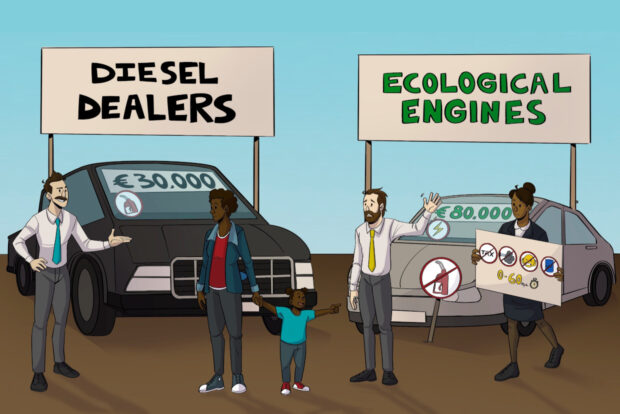
Winning support for positive change is easier, said Chisholm, when governments can demonstrate a range of benefits reaching beyond the relatively intangible goal of slowing climate change. “We’ve been very strong in our marketing and communications on things like trees and improved air quality, as well as electric vehicles – which offer much higher performance,” he said. “Most people find it very hard to relate to probability-based risk assessments about the future consequences of differences in temperatures: all the polling and survey research shows that that’s not something that people find easy to compute. So we have to find ways to make it clear there are other benefits.”

Such considerations must be weighed against purely science-based calculations of how best to cut emissions, suggested Simon Willis, Vice President for Public Sector Innovation at event knowledge partner Mastercard. “We’re sponsoring a big tree-planting programme ourselves, and what we’ve found is that if you pursue the purely scientifically optimal approach, you end up planting trees in places where most governments probably wouldn’t win many political points for planting them,” he said. Planting in parts of Africa, South America or South-East Asia might yield the greatest emissions benefits in the short term, but it’s easier to retain public interest and support among the people funding the work if their own neighbourhoods also see improvements.
In the UK, said Chisholm, the public are starting to get the message about the multiple benefits of greener lifestyles. Electric vehicles have outsold diesel-powered cars for the last two quarters in the UK, he said, and people have recognised that energy-efficient homes are more comfortable and cheaper to run. “There’s the beginnings of real demand, so that’s been critical to our plans for net zero,” he said.
Leading by example
It’s important that the government lead by example, Chisholm added. “We’ve been putting a big effort in trying to invest in public sector buildings and land use,” he said – with a £1bn [US$1.4bn] decarbonisation programme. “And we found that we were able to finance a lot of that activity through the private sector, through a scheme that has an underlying guarantee built into it by government. It has provided a lot of very low-cost financing for public sector decarbonisation schemes. Those types of schemes are very practical, and they’ve also been quite motivational for staff.”
Canada too has been working to decarbonise its federal public service buildings, said Michael Wernick, former Clerk to the Privy Council in Canada. It’s a slow process, though, with half of government’s space rented from private landlords and many ageing buildings on its books. Often, he commented, “it is just not cost-effective to retrofit them, and that has been one of the sticking points for us in terms of the decarbonisation of government itself.”
Tacking into the headwinds
Wernick also focused on the need to win public support for action on climate change – and to address the political headwinds. In North America, he pointed out, climate sceptics and populist politicians fiercely oppose investments and taxes designed to reduce emissions: “Economists would always say the best way to induce behavioural change is price signals, but it’s hotly, hotly contested,” he said. “Electric vehicles are the subject of culture wars in North America now: you declare your political allegiances by whether you’re willing to buy an electric vehicle or not. Congestion charges, tolls on bridges… there’s always somebody will run on removing them.”
In part, suggested Chisholm, the answers lie in using fiscal policy – both to share the costs of greening our societies, and to protect the vulnerable through essential changes. “Obviously, taxation is very progressive as rich people pay a lot more than poor people,” he said. “But that isn’t the case when you turn on the electricity: it doesn’t discriminate according to the wealth level of the household. So, there’s a balance to be struck there between recovering the cost of [green initiatives] from users and consumers, versus taxpayers. Getting that right is probably one of the biggest things in maintaining popular support and acceptance.”
The Global Government Summit was held online in late January; this is the third of four reports on its sessions, covering the discussion on environmental sustainability. The first covered Singapore civil service head Leo Yip’s introductory remarks; the second, the discussion on how to address risks across government; and the fourth, the challenges of contemporary civil service leadership.
To ensure that people can speak freely at the event, we give those quoted the right to anonymise or edit their remarks before publication.
Like this story? Sign up to Global Government Forum’s email news notifications to receive the latest updates in your inbox.

About Adam Branson