People, skills, partners: GGF study outlines the foundations for future-ready government digital capability

A new study by Global Government Forum explores how government organisations can ensure they have the right people, skills and partners to deliver on their digital visions.
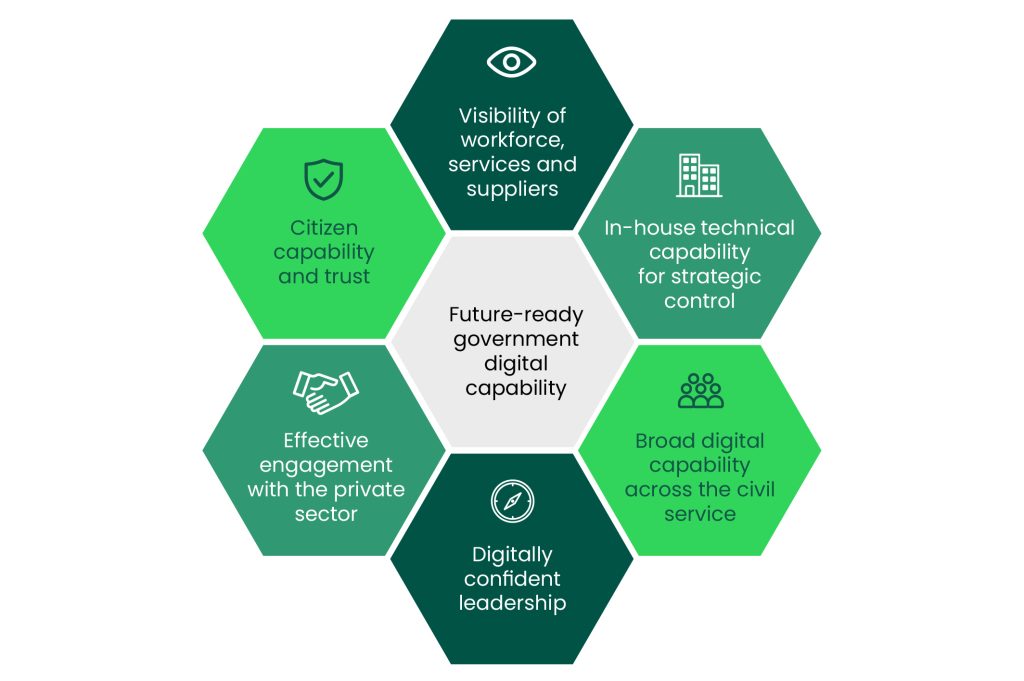
The report identifies six common foundations that underpin digital capability across governments, and how to make sure these foundations are resilient in a fast-changing environment.
The study was led by Kevin Cunnington, executive advisor, Global Government Forum, and former director general of the UK Government Digital Service.
“Throughout the last decade, digital transformation has been a goal for many governments and remains a work in progress,” he said. “While many are still grappling with digitising services, the ‘game’ has already changed. We have entered a second era of transformation where digital platforms produce the data that fuels AI, enabling far more proactive, personalised and integrated services, and fundamentally changing the way work is done.”
He added: “The ability to meet today’s expectations and capitalise on tomorrow’s opportunities depends on capability – governments need a clear understanding of their digital service priorities; strong in-house technical capability to retain control; a workforce that is confident in using digital tools and approaches; and a strategic approach to engaging and shaping the supplier ecosystem. They also need to ensure citizens are well-equipped to adopt digital services.”
Progress, persistent challenges and a widening gap
Based on interviews and a roundtable with over 20 digital leaders from around the world, including the UK, the US, Canada, Singapore, Australia and New Zealand, the report finds that significant progress has been made on digital capability: specialist digital professions have been created, new approaches to recruitment and pay have been introduced, training programmes have been established, and governments have reformed how they engage with suppliers and the market.
Several, but not all, governments have a professional centre tasked with improving digital capability, and job titles are emerging with this specific remit, such as director of government digital capability and director of digital workforce transformation. There are strong examples of a strategic focus on digital capability, such as dedicated digital and data workforce plans.
Despite this, senior leaders across very different systems continue to describe digital capability as a pressing issue and a moving target. Progress has not kept pace with the growth of digital government and at the same time, the nature of capability challenges is evolving with the rise of tools such as artificial intelligence.
As one interviewee put it: “The competency level is not where we would want it to be, ultimately, considering how fast things are progressing and moving in the digital and AI space”.
Another reflected that: “We have had some successes, but we are not where we want to be.”
Others were blunter about the scale of the challenge still ahead. “I’m somewhat pessimistic about the state of affairs here,” one leader admitted. “There’s so much work for us to do.”
Several pointed to a growing imbalance between investment in technology and investment in people. As one interviewee observed: “We’re spending money on these systems and solutions, but do we have the personnel, and are we spending time looking at our capabilities? That’s where the gap is happening.”
Download the report
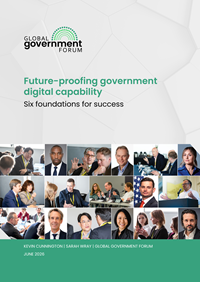
Future-proofing government digital capability: Six foundations for success
The evolving capability challenge
The imperative has sharpened further as digital has become integral to how modern governments function and deliver public services. Emerging technologies, particularly artificial intelligence, are intensifying expectations and changing how work is carried out.
One leader noted that AI is “democratising” technology to the point where there is “no longer a differentiation between a tech person and a non-tech person”.
Another said: “I believe civil services are going to change radically over the next five to ten years.”
“These massive service silos are going to go and there’ll be one service desk for government, there’ll be AI chatbots, there’ll be one web portal,” they explained. “All governments will go that way, so they need to think about what sort of skillsets they need today that will navigate to this new world.”
Against this backdrop, governments agree on the importance of digital capability and many of the core elements required, though their approaches to building and sustaining capability vary across systems.
“While there is no magic bullet, there is real scope for international collaboration to accelerate progress.”
The report finds that strengthening these foundations will be critical if governments are to move beyond reactive interventions, and explores how they are responding to these key trends to build capability that can evolve with technological and strategic change.
Examples include changing methods to assess technical capability as skills profiles evolve; programmes to upskill all civil servants and improve digital literacy among citizens; initiatives to improve digital capability among senior leaders; new ways of engaging with the private sector; and efforts to recruit and retain digital talent.
“Digital capability can no longer be treated as a discrete function or a one-off investment; it must be actively designed, measured, and built as a system-wide capability that evolves with change,” said Cunnington. “While there is no magic bullet, there is real scope for international collaboration to accelerate progress. There could be shared definitions and methodologies that help; mapping critical services together could cut duplicative work; and approaches to achieving a ’digital first’ culture could scale across borders.”
He added: “I hope you find this study informative. More importantly, I hope it provides you with evidence and practical ideas to build a government capability that is truly fit for the future.”
GGF will now take the collaborative opportunities identified in this report forward – if you’d like to be involved, get in touch by emailing [email protected] so we can structure the work to be as useful as possible.
Download the report
Future-proofing government digital capability: Six foundations for success

About Sarah Wray
Sarah has over 15 years’ experience as a journalist with a specialism in the public sector and topics such as digitalisation and climate action. Sarah was formerly the editor of Cities Today and Smart Cities World, as well as a specialist video-based publication in the aerospace sector. She has also written for publications including Smart Cities Dive, Mobile Europe, Mobile World Live and Computer Weekly.

Related Posts