First climate ‘tipping point’ has been crossed, finds major report in stark warning ahead of COP30

As global warming approaches 1.5°C, climate ‘tipping points’ are being crossed that pose “catastrophic risks to billions of people”, according to a new report by 160 scientists worldwide.
The Global Tipping Points Report 2025 states that coral reefs are crossing a dangerous threshold and experiencing unprecedented dieback, in what scientists described as the first “tipping point” in climate-driven ecosystem collapse.
Parts of polar ice sheets “may also” have crossed a tipping point “that would eventually commit the world to several metres of irreversible sea-level rise affecting hundreds of millions”, it said.
In addition, a major ocean current called Atlantic Meridional Overturning Circulation is at risk of collapse, and tipping points related to mountain glacier retreat and the dying back of the Amazon rainforest are looming.
Crossing these tipping points – which in climate science are critical thresholds that, when breached, lead to large, accelerating and often irreversible changes in the climate system – would have impacts such as the “radical undermining” of global food and water security, severe and prolonged winters in northwest Europe, and “incalculable damage to biodiversity”.
“How hot we let it get and for how long really matters in preventing climate tipping points. The magnitude and duration of global temperature overshoot above 1.5°C has to be minimised,” the report warns. The world has already reached global warming of 1.4°C.
Read more: China commits to carbon reduction target for the first time
Global greenhouse gas emissions ‘must be halved’ by 2030
To achieve this, it said global greenhouse gas emissions must be halved by 2030 compared to 2010 levels, and reach net zero by 2050.
“This requires an unprecedented acceleration in decarbonisation, rapid mitigation of methane emissions and other short-lived climate pollutants and fast scaling of sustainable carbon removal from the atmosphere.”
It said that current nationally determined contributions – the climate change pledges individual countries make that sit at the heart of the Paris Agreement – and binding long-term or net zero targets “are not enough” and commit the world to ongoing global warming that will likely exceed 2°C before 2100.
“This demands immediate, unprecedented action from leaders at COP30 and policymakers worldwide.”
Though the report notes a “recent spate of backsliding on commitments in some nations and sectors, including finance”, it also highlights positive changes since the first Global Tipping Points Report was released in 2023.
Read more: Countries have a legal obligation to tackle climate change, International Court of Justice rules
This includes acceleration in the uptake of solar power and electric vehicles worldwide, and ‘positive tipping points’ – self-reinforcing shifts in policies, technologies, finance, and behaviours that can drive change at unprecedented speed and scale – which it said are “starting to interact and reinforce each other”.
“Only with a combination of decisive policy and civil society action can the world turn from facing existential climate tipping point risks to seizing positive tipping point opportunities,” the report said.
Tim Lenton, environmental scientist at the University of Exeter and lead author of the report, said that while “change is happening fast now, tragically, in parts of the climate, the biosphere”, there were also positive signs, such as the phasing out of fossil fuels most responsible for climate change.
Renewables, for example, accounted for more electricity generation than coal this year for the first time, according to data from the nonprofit think tank Ember.
Read more: Integrate mission governance into climate policy, says OECD
Change narrative ‘from fear to hope’, says COP30 president
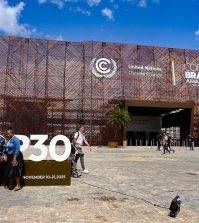
Though the report’s message is stark, André Aranha Corrêa do Lago, president of COP30 – which will take place in Belém, Brazil, between 10-21 November – said his vision for the conference is to “transform the narrative of tipping points from fear to hope”.
In the foreword of the report, he said: “We must prevent irreversible harm but equally trigger positive tipping points that can propel societies towards low-carbon, resilient development and inclusive prosperity.”
This would require global ‘Mutirão’, the Portuguese word for ‘collective action’ and theme of COP30, where “all nations and communities act together, by choice, to build a future not imposed by catastrophe, but designed through cooperation”, Corrêa do Lago said, adding that the report is “not only a warning but a guide: it maps where dangers converge, but also where opportunities to tip systems positively are within reach”.
As well as focusing on crossed and approaching tipping points, the report also outlines how to prevent them, including through governance, local action and the input of civil society. It covers recent progress and the transition away from fossil fuels, and sections on finance, climate justice, sustainable production and consumption in the food system, and the regeneration of nature.
“The time to act is now. United, we can reverse the dangerous trend towards a sequence of systems collapses in domino effect. Let us build on and support each other to prevent a potentially devastating chain-reaction. Let us trigger instead a ‘chain of action’, for exponential low-carbon and climate-resilient solutions worldwide. Let us change by choice, together,” Corrêa do Lago concluded.
The three primary objectives of COP30 are to reinforce multilateralism – “because only united can we safeguard the climate regium and make it deliver”, to connect climate action with people’s lives, and to accelerate the implementation of the Paris Agreement “inclusively, and beyond negotiating rooms”.
The last two years were Earth’s warmest on record. The world is currently on track for about 3.1°C of warming in this century, based on national policies.
Read more: COP30 president calls for ‘global NDC’ to spur collective action on climate change

About Mia Hunt
Mia has been editor of globalgovernmentforum.com since 2019. She has 15 years’ experience as a journalist and editor and specialises in writing for civil and public servants worldwide, including covering sustainability policy and related issues. She has led the Global Government Women’s Network since it launched in 2023. Previously, she covered commercial property having been market reports and supplements editor at Property Week and deputy editor at Retail Destination. She graduated from Kingston University London with a first-class honours degree in journalism and was part of the team that produced The River newspaper, which won Publication of the Year at the Guardian Student Media Awards in 2010.