The future of work in the age of AI agents
The advance of Artificial intelligence (AI) is quickly changing tasks, skills and leadership expectations across the public sector and the introduction of AI agents will only accelerate the pace of change.
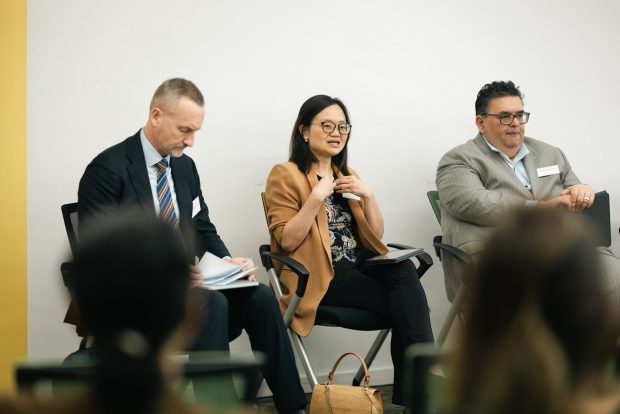
In a workshop session that was developed in partnership with Workday and which formed part of Global Government Forum’s Leaders’ Forum event programme, public service leaders from the Government of Singapore and other countries came together to discuss how governments are redesigning job roles and workflows to make the most of AI. They also explored the workforce development and change management approaches required to prepare public servants for effective collaboration with the imminent introduction of AI agents.
Instead of only viewing AI as a productivity and efficiency tool, participants recognised that the transition to working with AI agents could drastically improve the quality of governance and government service and fundamentally redefine the nature of public service. This necessitates a comprehensive approach to workforce development and change management to ensure public servants can collaborate effectively in the age of AI agents.
This article provides a summary of the key points discussed by public servants.
Rethinking service delivery models in the age of the ‘digital teammate’
Governments are entering a transformative phase where AI shifts from being a mere software tool to a digital teammate capable of acting and learning autonomously within defined guardrails. This evolution is not solely about productivity or “doing things better”; it is about “doing better things” by improving service quality and effectiveness, as noted by one participant.
“Doing better things” in government includes moving from agency-centric delivery to “citizen journey” or “life-event” models which create anticipatory systems that allow governments to be more proactive with AI agents being able to offer services to users based on triggers around specific events.
This model allows for highly personalised interactions between public service and an individual. For instance, a citizen seeking one specific service might be guided toward several others that are relevant to their unique circumstances, based on existing data. Workshop participants noted that this level of targeting is achievable without a massive influx of additional manpower as AI allows for the scaling of essential services that were previously limited by human labour constraints, particularly in regions or organisations facing talent shortages. Ultimately, this transformation is viewed not just as a technological deployment, but as a fundamental exercise in rethinking how the public service workforce delivers value.
Job redesign: Architecting the human-AI partnership
The conversation also covered how governments can re-think roles in public services to emphasise humans working on what only humans can do, such as tasks that require empathy, ethical judgement, and conflict resolution.
To achieve this, the workshop highlighted that organisations are beginning to categorise work into “three buckets”:
- Tasks AI does better: Robotic, transactional, or high-volume data processing tasks that AI performs with greater efficiency.
- Tasks humans do better: Tasks requiring human-centric skills such as empathy, ethical judgment, r elationship building, stakeholder engagement .
- Complementary tasks: Collaborative tasks where humans and AI work in tandem, such as “policy red-teaming” or sophisticated forecasting.
Under this model, working alongside AI becomes a core component of every public servant’s role. And the goal is to create a “fleet of agents” that manage workflows and enhance the capacity of officials to focus on deliberative, high-quality work.
However, participants also highlighted that for most organisations, a key challenge lies in re-orchestrating its current workforce, both in terms of job roles and work processes to make the most of the technology.
How to make the change happen
The session then moved on to touch on the barriers we need to address to enable this change, with discussion covering both the need to boost confidence among leaders, managers, and frontline officers about the use of AI.
Participants emphasised that AI systems must be “responsible by design” to foster the necessary trust for widespread adoption. A key element of this trust is the principle of “human-driven” decision-making, where the roles of technology and people are clearly defined.
For example, in areas like recruitment, AI can be used to automate administrative tasks and provide constant feedback to candidates, yet the final hiring choice remains a human responsibility. Success in this transition depends on a combination of trustworthy tools, competent personnel, and clear organisational policies. As public expectations rise and competition for talent intensifies, treating the adoption of AI (and agents) as a journey of workforce transformation is critical.
The session closed with one participants setting out the potential for AI in an inspiring vision and illustrating why those who succeed will treat AI as a workforce transformation journey, not a technology deployment project.
Most public sector organisations are at the beginning of using AI. “There’s a lot of excitement,” they said. “There’s a lot of experimentation about different types of generative AI tools, automating administrative tasks, and freeing public servants to focus on the mission-driven tasks that brought them to public service in the first place.”
They added: “We’ve also heard about the expectations and pressures that governments function under… and with rising expectations from the public, there is a need to use technology in the best way possible to do more with less.
“The challenge is: how do we make our recruitment processes better? How do we make it easier for young professionals to come into public service and streamline those processes? And also give our employees the tools that they need to make their work more satisfying.
“That is going to be critical for public sector organisations that are competing for talent and hoping to deliver on national outcomes.”

About Partner Content
This content is brought to you by a Global Government Forum, Knowledge Partner.