Drawing on international best practice: Five minutes with Gillian Dorner, deputy director of the OECD’s public governance directorate
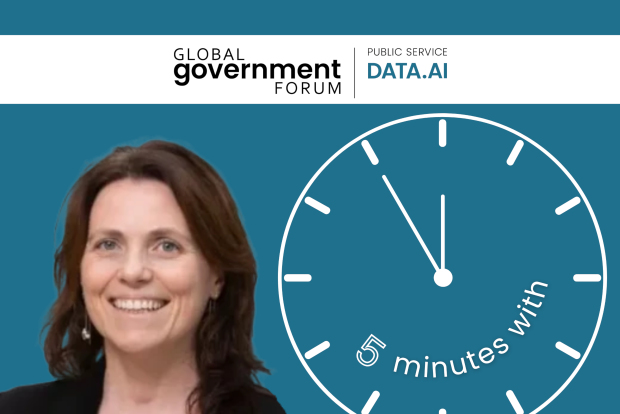
This interview with Gillian Dorner, deputy director, public governance directorate at the OECD, is part of a ‘Five minutes’ series featuring speakers from Public Service Data.AI, taking place in London on 18 September 2025.
In it, she speaks of the importance of seeing public service as a calling, governing with AI, and swimming in the Seine at weekends.
What are you most interested in discussing at Public Service Data.AI 2025?
I am looking forward to hearing about some of the challenges UK civil servants face in ensuring the effective use of data and AI in government and how we at the OECD can draw on international best practice to support progress.
What drew you to a career in the public sector?
I will be honest and say that I kind of fell into it. I was looking for graduate opportunities after my degree and thought I would give the Fast Stream a go. I am so glad I did!
Explainer: Fast Stream is the UK government’s accelerated development programme for the civil service, which provides talented graduates with the core skills needed to become the future leaders of government departments.
What have you achieved in your career that you’re most proud of?
My greatest achievements have always been when I have worked as part of a team, often under significant pressure. While they weren’t the easiest periods in my career, I am incredibly proud of what we achieved at HM Treasury and the Cabinet Office in response to the financial crisis and COVID-19. There were many long hours and little sleep, but what we achieved in a short period of time was quite incredible.
What advice would you give someone starting out in the public sector?
I would say ‘Don’t just see it as a job, see it as a calling!’. You will get so much more out of it and, quite possibly, progress further as a result. We spend so much of our lives working. It is important to feel passionate about it.
What do you like most about working in the public sector?
I am going to change this question slightly and tell you what I liked most about working in the UK Civil Service. Having spent time in the French civil service and in an international organisation (the OECD), I have really been able to step back and appreciate the strengths of the UK system. In particular, I like the way UK civil servants, particularly those on the Fast Stream, are thrown in the deep end from day one and given real responsibility. There is also a huge amount of flexibility in career paths. This is how you learn and I am forever grateful for the experiences I had throughout my early career that have allowed me to pursue the opportunities I have today.
Dorner will be speaking in the session ‘How to make AI implementation happen at scale’ at Public Service Data.AI, alongside Dr Tom Smith, director artificial intelligence and advanced analytics at the UK’s Ministry of Housing, Communities and Local Government; and Claire Harrison, chief digital and technology officer at the UK Medicines and Healthcare products Regulatory Agency.
Find out more and register to attend the event here
Which country’s government department or agency are you most inspired by and why?
We have recently been conducting a digital government review of Korea along with their Ministry of the Interior and Safety. I am so impressed by their strong leadership, cultural emphasis on speed, and early e-government priorities that have positioned them firmly as a global leader in this space.
What upcoming OECD work related to data and AI might civil and public servants find particularly valuable?
Look out for the OECD’s upcoming report Governing with AI: The state of play and the way forward in core government functions. This report will provide analysis focused specifically on AI in government, including its benefits and risks; current and emerging trends based on 200 cases across 11 core government functions; implementation challenges governments face in adopting AI; and the enablers, safeguards and engagement mechanisms governments can put in place to ensure the trustworthy development and use of AI.
Do you have any unusual hobbies?
Since COVID, I have been doing online workouts with a group of ladies from all over the UK. Even though we only get to meet in person every so often, some of them are now my best friends. I think my husband thinks I have joined a cult!
What is your favourite thing to do at the weekends?
Our most recent favourite activity is to go swimming in the Seine just down from the Eiffel Tower. So much fun and the water is surprisingly clean!
What is your most treasured possession?
My children. Although, they would certainly not agree that I possess them.
Public Service Data.AI
The Public Service Data.AI annual conference, held in London, will hear from leaders from across the UK government and wider public sector, as well as from other countries and international organisations, on how to improve the way data and AI are used in the public service.
Sessions will include a keynote address from Lindsay Mason, chief data officer of the UK government, to kick off the event, and a closing session on how to make AI implementation happen at scale.
Speakers across the conference will include David Knott, the UK government’s chief technology officer; Ott Velsberg, chief government data officer of Estonia; Ming Tang, chief data and analytics officer at NHS England; and Dr Malkiat Thiarai, head of corporate information management and data protection officer, Birmingham City Council.
The event is free to attend for civil servants, public servants and those working in the wider public sector.

About GGF reporter

Related Posts