Improving data, AI and evidence-led decision-making: takeaways from AccelerateGOV 2025

Use of data and AI in government is becoming ever-more important, so these themes were high on the agenda at AccelerateGOV 2025, with evidence of real progress being made on deploying AI
A survey of AccelerateGOV attendees showed that real progress is being made in making use of data and AI. Regular use of data and evidence to guide decision-making was ranked top by respondents in the factors that have enabled their organisation’s digital progress to date, with 52% saying it had been somewhat or highly effective.
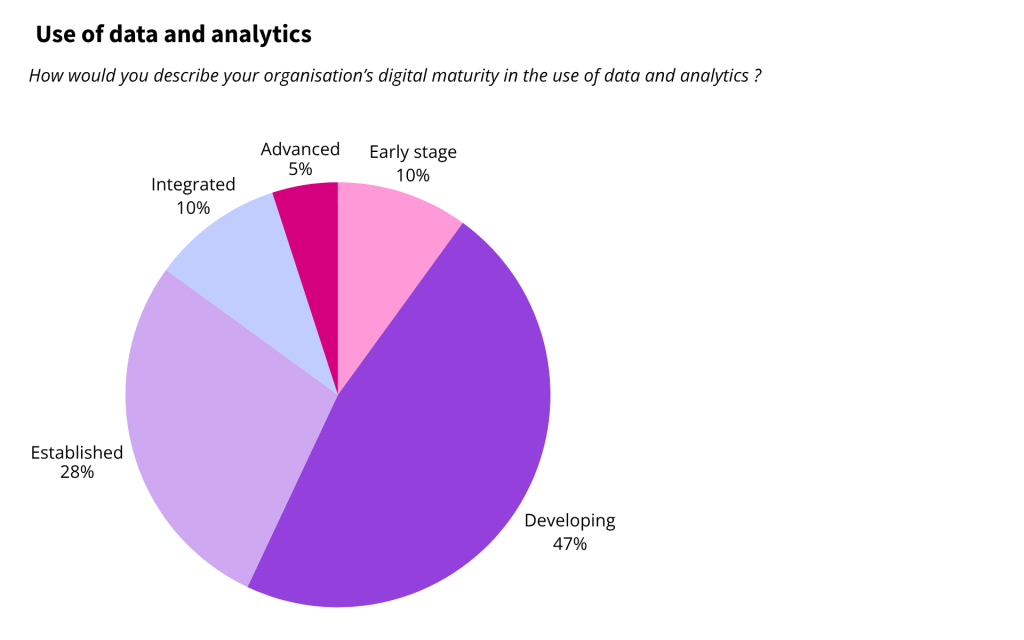
Most survey respondents characterise their organisation’s use of data and analytics as developing (47%), with 28% describing it as established, and 15% integrated or advanced.
Meanwhile, survey respondents expect AI to be the most impactful technology in government over the next five years, with almost 80% expecting it to have a significant or high impact.
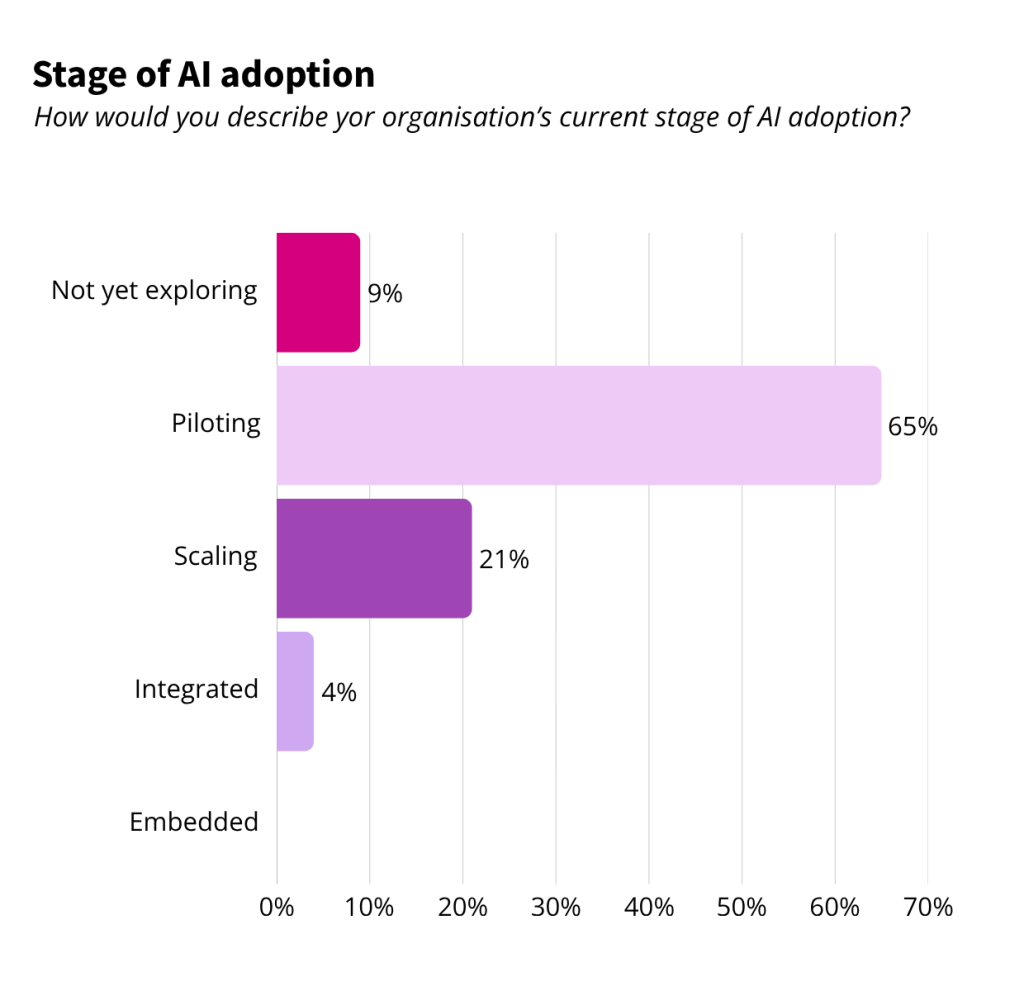
The vast majority – almost two-thirds (65%) of survey respondents – described their organisation’s stage of AI adoption as ‘piloting or experimenting’ and 21% said they are scaling in selected functions. Just 9% said they were not yet exploring AI, and 4% described it as integrated across multiple operations.
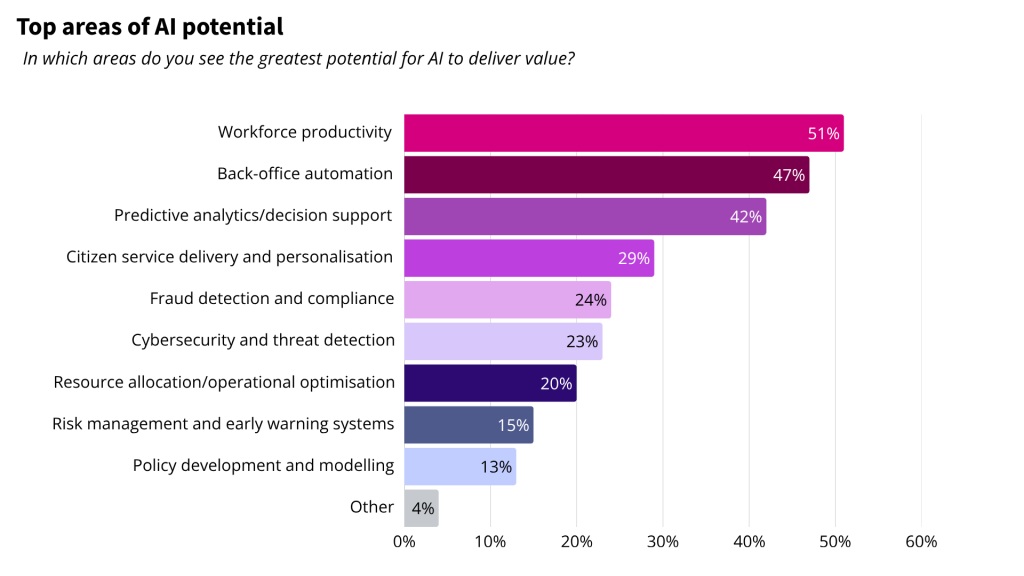
Survey respondents see the greatest potential for AI to deliver value in productivity (51%), followed by back-office automation (47%), predictive analytics and decision support (42%), and citizen service delivery and personalisation (29%).
Accelerating AI adoption
Throughout the conference, experts discussed how to unleash the full potential of data and AI and overcome blockers.
During a panel on moving from AI hype to delivery, Kara Beckles, executive director, privacy and responsible data, Office of the Chief Information Officer, Treasury Board of Canada Secretariat, explained that Canada’s first strategy for AI in the public service was created to shift thinking away from fear and restriction towards responsible experimentation. Although policies already existed, some public servants felt they “weren’t allowed” to use AI. In response, the strategy aimed to “change the conversation around AI… to one where we can accelerate the adoption of AI” and help departments identify “what’s that pebble in your shoe [and] is this the technology that can help you get rid of that irritation?”
“What’s that pebble in your shoe … is [AI] the technology that can help you get rid of that irritation?” Kara Beckles, executive director, privacy and responsible data, Office of the Chief Information Officer
The strategy rests on four principles: human-centred, collaborative, AI-ready, and responsible. Concrete actions include creating central AI expertise, modernising policy and governance, strengthening talent, and improving engagement and transparency. Early deliverables include an AI registry listing “over 400 use cases across government” and “lighthouse projects” like GC Translate.
Elise Legendre, chief data officer, Agriculture and Agri-Food Canada, highlighted the operational reality facing government departments: limited resources, fast-moving technology, and the need for flexibility. She praised the strategy for giving departments “the ballpark, the fences around the ballpark, without telling us what we could or couldn’t do within the ballpark”, allowing teams to innovate responsibly.
She stressed that people and capacity-building are key to moving from hype to implementation. “Data is nothing without the context,” she said, noting that teams must challenge outputs for bias, interpret results and apply judgment. Leaders, she said, must create safe spaces for experimentation and accept imperfection: “Being rigorous doesn’t mean being perfect… we often confuse being responsible and rigorous with being perfect, and I think we get in our own way that way.”
AI offers “one of the biggest opportunities… to improve the lives of our citizens and to make better quality public services”
Liam Wilkinson, head of AI incubation, UK Government Digital Service
Liam Wilkinson, head of AI incubation, UK Government Digital Service, reinforced the centrality of public trust: “Whenever we are applying AI, we have to be really transparent with the general public, lead with our principles and talk about how we are using AI,” he said, noting that both the UK and Canada are taking a “principles-based approach” and using measures such as algorithmic transparency standards and registries.
He also emphasised data readiness and talent. AI offers “one of the biggest opportunities… to improve the lives of our citizens and to make better quality public services”, he said, but acknowledged the need to address longstanding data issues and actively recruit technical talent – motivated not just by pay, but by “a mission… to really make AI for the public good”.
AI and productivity
Another session focused specifically on how artificial intelligence can lead to greater productivity, which was the most promising use case for our survey respondents.
Nadine Boudreau-Brown, director-general, transformation and modernization services, Information Systems Branch, Agriculture and AgriFood Canada, described how generative AI tools are now available to about a third of the department’s workforce. The results have been striking: teams are seeing a 50% to 80% reduction in time spent on drafting, summarising and synthesising content. In scientific work, predictive AI models that once took weeks now deliver results in hours, “really speeding up discovery” and allowing more timely advice to agriculture producers.
Basic automation is still “underutilised”, Boudreau-Brown said, describing how an automated loan balance calculator means work that used to take hours now takes minutes, while also reducing risk, improving accuracy and accelerating decisions.
Janak Alford, deputy minister of technology and innovation, Government of Alberta, Canada, reinforced this picture of rapid gains.
Alberta is applying AI in several areas, including workforce enablement. The government has procured enterprise AI licences for about a quarter of the Alberta public service and has developed an accompanying academy programme. After only weeks of training, staff are reducing “days into hours, hours into minutes”, he said.
The province is also applying AI to contracts, grants and procurement, modernising billions of dollars’ worth of agreements. In technology operations, work to support software migration – including code reviews, scanning, and cyber checks – that once took “around 40 days” per application has been reduced to “around 40 minutes”, Alford said.
A striking example of AI implementation came from Albania. Romina Kostani, director of digital agenda coordination and foreign-funded projects for e-government, National Agency of Information Society, Albania, explained that the country now delivers “95% of central government services online”, with no in person service counters. Its new AI assistant, Diella, can answer questions and issue official certificates “in a few seconds”. The tool has evolved from being chat-based and now has a voice-based avatar.
And Albania has gone even further, appointing Diella as the world’s first ‘AI minister’, which will soon participate in government meetings to provide policy suggestions based on government data. As an EU candidate country, Albania is also using AI to speed up the process of aligning its national legislation with European Union requirements.
Based on OECD analysis of 200 AI use cases in over 80 countries, Dr Carlos Santiso, senior adviser on digital government and artificial intelligence in government, OECD, said that governments are using AI mainly to improve efficiency and simplify processes, strengthen integrity in public finance through fraud detection in areas such as welfare and procurement, and improve policy design, particularly in social welfare.
“Probably the biggest use case is really improving the quality of public services,” Santiso said, explaining that a lot of countries are using AI to try and deliver services around life events rather than departmental silos – “where you integrate the actions of different public entities to provide integrated services to a mother that has just given birth to a child, for example”.
Santiso concluded that government practice is shifting away from AI being used mainly as a compliance and fraud tool toward using it to improve how services reach and support citizens, especially vulnerable groups.
He emphasised too the importance of purpose, noting that in government AI strategies, “the objectives of deploying AI are not always explicit”.
AI tool wins public service challenge
During AccelerateGOV, the winner of the Public Service Data/AI Challenge was announced.
The challenge seeks ideas from federal public servants on how government can improve its use of data and artificial intelligence, with plans developed over a series of rounds.

This year’s winning project, announced by programme champion Debbie Scharf, assistant deputy minister, strategic policy and innovation, Natural Resources Canada, is an AI-enabled job classification for the federal public service. It aims to speed up the process of determining salary level and occupational group for public service jobs.
The AI Classification Enabler leverages a repository of over 30,000 job descriptions and classification documents, streamlining key elements of the job classification process while maintaining expert human oversight. The system is intended to enable faster hiring and reorganisation so the public service can work more effectively for Canadians.
The Public Service Data/AI Challenge is organised by Statistics Canada, Natural Resources Canada and Global Government Forum, and supported by the Treasury Board of Canada Secretariat and knowledge partners IBM, Dell and Nvidia.
This is the fourth installment of Accelerating government transformation: Takeaways from AccelerateGOV 2025. You can read the report in full here, and register for AccelerateGOV 2026 here.

About Sarah Wray
Sarah has over 15 years’ experience as a journalist with a specialism in the public sector and topics such as digitalisation and climate action. Sarah was formerly the editor of Cities Today and Smart Cities World, as well as a specialist video-based publication in the aerospace sector. She has also written for publications including Smart Cities Dive, Mobile Europe, Mobile World Live and Computer Weekly.

Related Posts