‘I see AI much more as a service and leadership challenge than a technology one’: interview with Phil Swan, director for government digital enablement, UK Government Digital Service
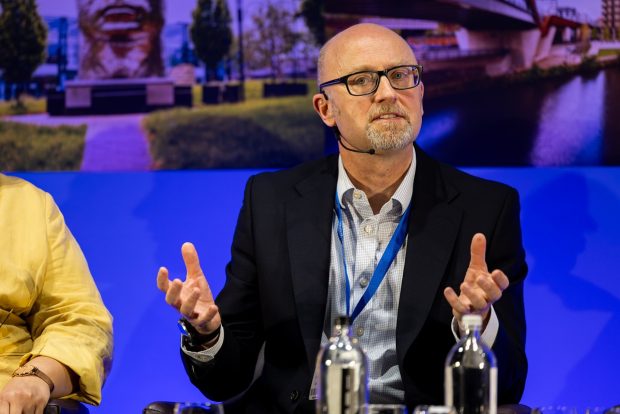
Phil Swan recently joined the Government Digital Service (GDS) as director responsible for GDS Local, service standards, inclusive digital design, and digital workforce and capability. He moved to the role after eight years as director of digital at the Greater Manchester Combined Authority.
In this interview, following GGF’s Global AI Cities summit and conference, Swan sets out the potential for AI in local government, how central government can help – and how events like Global AI Cities can drive collaboration between cities to share AI best practice and insights.
What is the potential of artificial intelligence in local government – and how can the Government Digital Service help authorities realise this?
I think the opportunity for AI in local government is enormously significant, particularly around managing demand and improving how frontline services operate. But the issue isn’t a lack of ideas – it’s how you move from lots of small pilots to something that actually works consistently at scale.
For me, that’s where GDS has a really important role – giving local authorities clearer standards, shared patterns, and more confidence about what ‘good’ looks like. We are also building capability through programmes like the AI Accelerator, and supporting some of the emerging cross-government AI initiatives being taken forward – all designed to make it easier to move from experimentation to scaled impact.
People from local government have joined our AI Accelerator talent programme, which upskills data scientists into AI specialists while helping to tackle live public sector challenges. The aim is to make it easier to reuse what works in AI and avoid everyone solving the same problems over and over again.
Before joining the Government Digital Service, you spent eight years as director of digital at the Greater Manchester Combined Authority. What are your lessons from this role?
My experience in Greater Manchester was very much about focusing on real problems – where AI could actually make a difference, rather than starting with the technology.
One example from my time in Greater Manchester was a fostering programme working across multiple local authorities, where we commissioned a shared digital solution to support recruitment and service delivery. What that really highlighted was that before you can scale more advanced capabilities like AI, you need to get the fundamentals right – consistent data, shared processes, and a system that works across organisational boundaries.
What I’ve taken from that is that, while there are technical barriers, it tends to be more about data quality, how confident people feel using it, and whether it fits into how services actually run day to day. If it doesn’t do that, it doesn’t stick.
There’s already an opportunity to do similar things at scale in GDS, as the senior leadership team is consistently looking for ways to realise success across better use of data, technology, commercial and AI capabilities. So I tend to see AI much more as a service and leadership challenge than a technology one – it’s about how you design it into the system so it actually gets used.
So, what should local authorities prioritise now to make the most of AI?
There isn’t a magic bullet. I think organisations should take a balanced approach that works on personal use and productivity of all staff, leadership, then processes, products or services that can be worked on as specific projects with clear intended benefits. All this needs capacity and a lot of great communications – it shouldn’t be a side of desk job for someone. What we’re really talking about here is shifting the culture of the organisation to make better use of technology.
A key factor is also getting honest about data – because that can be the limiting factor on projects – and putting some data governance essentials in place early so people are confident in what you’re doing.
If you get those things right – use cases, data, capacity and governance – you’re in a much stronger place to build and then scale from there.
How important are events like Global AI Cities in driving collaboration between cities to share AI best practice and insights?
I’m interested in how places have actually made this stick around the world — not just the pilots, but what’s been sustained and scaled.
A lot of cities are experimenting with AI, but it’s a fast evolving area and few have really embedded it into how services run. It’s important for me to understand how GDS, working with the Ministry of Housing, Communities and Local Government and the Local Government Association, can best support and enable that.
I think collaboration works best when it’s really practical. Not just sharing ideas, but sharing things people can actually reuse – approaches, patterns, ways of working.
Through GDS Local, we are enabling collaboration through shared data, common platforms and making GDS products available to local authorities. The goal is supporting local authorities to scale innovation and deliver simpler, faster, more joined‑up public services.
A lot of cities are tackling very similar problems, but doing it separately. So there’s an opportunity to be a bit more deliberate about aligning – even if it’s just agreeing what ‘good’ looks like in a few key areas.
That way you can move faster, and you also build a bit more confidence in how this is being done.
Read more: Local government leaders embrace AI challenges and opportunities at Global AI Cities conference
What are the barriers to scaling AI in local governments – and how can they be overcome?
The big barrier, in my experience, is fragmentation – lots of good things are happening locally, but they’re not always connecting up, or they’re being duplicated.
What that means is a lot of innovation stays quite local and never really scales. So the shift we need is towards a more connected system – clearer expectations, more shared capability, and much more emphasis on reuse. There’s also an opportunity to better leverage collective buying power across the system, so we’re not solving the same commercial challenges repeatedly in different places.
Local government tends to be very collaborative – in clusters – which is a positive, but collaboration across all of local government and between central and local government needs to improve, including working with combined authorities. If we can do that, we’re going to be able to have more impact at scale, rather than this being difficult every time.
That’s why we launched GDS Local, to bring central and local government together to co-create shared technology, standards and approaches that will help us create more joined-up services.
Phil Swan is director for government digital enablement at the UK’s Government Digital Service, and was a speaker at the Global AI Cities conference on 17 July.
Find out more about Global AI Cities here, and register your interest to attend next year’s event.
You can join the GDS Local newsletter here.

About Richard Johnstone

Related Posts