Korea, Australia and Portugal ranked top for digital government

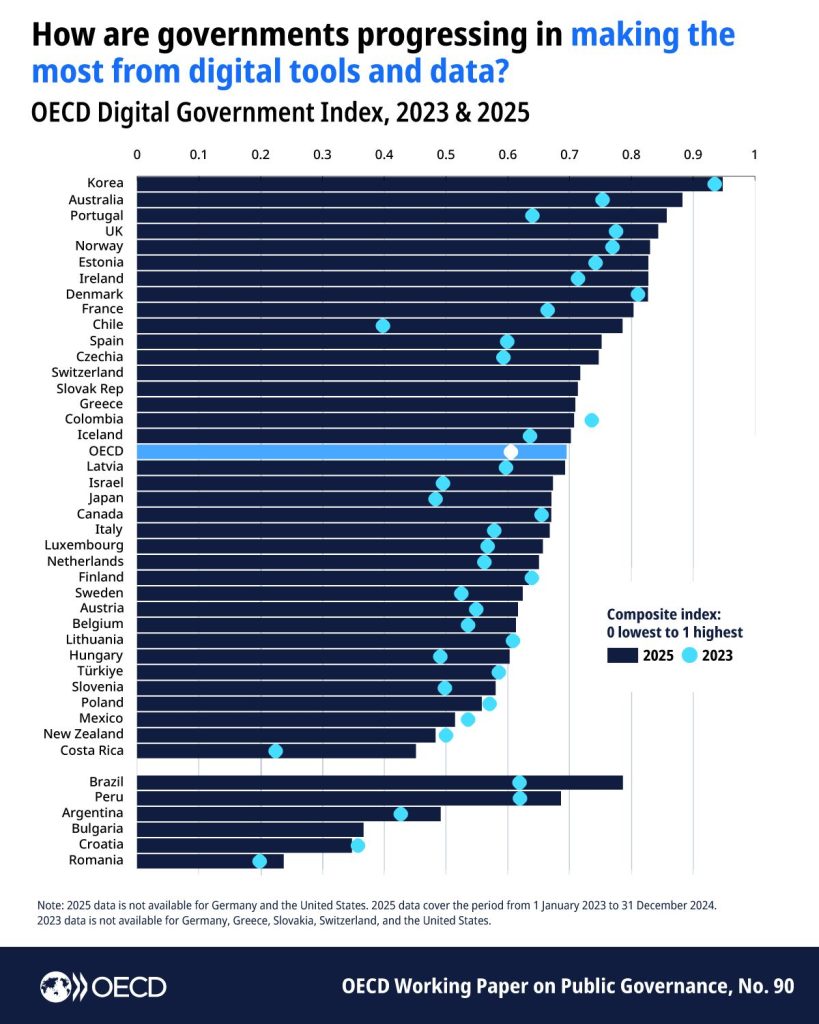
Korea, Australia and Portugal take the top three spots in the OECD’s latest Digital Government Index (DGI). They are followed by the United Kingdom, Norway, Estonia, Ireland and Denmark.
The index benchmarks 42 countries on policies and initiatives that enable digital transformation across six dimensions: digital by design, data-driven, government as a platform, open by default, user-driven, and proactiveness.
“The balanced performance of these countries across the six dimensions of the OECD Digital Government Policy Framework, as measured by the DGI, reflects their comprehensive efforts to implement digital government strategies and policies,” the OECD said in a report on the results.
The average DGI score increased from 0.61 (on a scale of 0-1) in 2023 to 0.70 in 2025, representing an overall increase of 14%. Nearly all governments scored above the 0.50 mark, with 17 above the OECD average. Korea scored 0.95, Australia 0.88, and Portugal 0.86. Chile, Costa Rica, Portugal and Japan were the countries with the most pronounced score increases. Korea also topped the 2023 index.
Progress drivers
The OECD analysis found that countries improved across all six DGI dimensions, with the largest gains in the data‑driven public sector, user-driven, and proactiveness dimensions.
“Progress was driven by stronger data governance frameworks, digital public infrastructure (e.g. interoperability systems), the use and governance of AI in government, and the wider adoption of service standards,” the report said.
It noted that progress has been more limited in areas such as digital by design, government as a platform, and open by default: “The comparatively modest gains in the first two dimensions largely reflect their already high levels of maturity, particularly in governance and cybersecurity. By contrast, areas such as digital investments and open data policies show comparatively low maturity levels and have not kept pace with progress observed elsewhere.”
Governance foundations for digital government have become stronger since 2023, the OECD said. It cited results in the digital by design dimension showing that OECD countries have reinforced institutional and legal frameworks for digital government, and expanded the scope of digital talent and skills strategies.
“However, bolder efforts could be taken to strengthen the monitoring and evaluation of digital government strategies and investments,” according to the report.
Read more: Major study with 12 UK permanent secretaries reveals key enablers to ‘rewiring the state’
Data advances
The results also suggest that data governance, sharing and use in governments are improving. Compared to 2023, the data-driven public sector results show that more OECD countries now have governance structures and senior leadership dedicated to steering how data is managed and used.
“Countries have slightly expanded the coverage of data interoperability systems, helping public bodies share and connect data more efficiently,” the OECD said. “However, more decisive actions are needed to increase the use and application of these systems to enable integration across the public sector.”
Innovation, taking place on 24 and 25 March 2026 in London, is a unique exhibition and conference that brings together government leaders from across the globe responsible for the transformation and acceleration of their public sector organisations and services. Co-hosted by the UK Government, UK Civil Service and the Cabinet Office, it covers innovation across a range of topics, including data, digital transformation, workforce, culture, sustainability, and more. Find out more about Innovation 2026 and register to attend here
Leading strategies
The OECD’s recent Digital Government Review of Korea put the country’s digital strength down to factors such as strong political leadership, centralised governance, and a co-ordinated institutional model led by the Ministry of the Interior and Safety.
“National strategies, cross-government collaboration, and high-performing digital infrastructure support consistent, long-term progress,” the review said. “Investments in digital government, guided by structured planning, central oversight, and standardised procurement processes ensure that initiatives are aligned with national priorities and deliver value for money.”
Australia’s Digital Transformation Agency (DTA) cited sustained investment in governance, shared platforms and user-centred services across government as key to its high ranking.
This includes initiatives such as the Data and Digital Government Strategy; the Digital Experience Policy and the Digital Service Standard; and the AI Plan for the Australian Public Service.
“Australia’s Data and Digital Strategy set an ambitious goal to achieve world-class data and digital capability by 2030,” said Chris Fechner, chief executive officer at the DTA.
“This result is a testament to the immense progress we are making across government to strengthen how services are delivered across our community and positions Australia as a global leader in digital government.”

About Sarah Wray
Sarah has over 15 years’ experience as a journalist with a specialism in the public sector and topics such as digitalisation and climate action. Sarah was formerly the editor of Cities Today and Smart Cities World, as well as a specialist video-based publication in the aerospace sector. She has also written for publications including Smart Cities Dive, Mobile Europe, Mobile World Live and Computer Weekly.

Related Posts