New GGF research: Canadian public servants report digital progress but ‘persistent’ barriers remain

More than half (53%) of Canadian public servants say their organisation’s digital capability is stronger than it was 12 months ago, according to new research from Global Government Forum (GGF). A further 40% say it is unchanged, while 7% report it has weakened.
Overall, the research indicates that digital transformation is moving forward, but key barriers remain.
At the same time, expectations around artificial intelligence are high. For instance, almost 80% of those surveyed expect AI to have a significant or high impact over the next five years, with most (65%) in the ‘piloting or experimenting’ stage, and 21% scaling in selected functions.
Writing in a foreword to the report, Dominic Rochon, deputy minister and chief information officer of Canada, Treasury Board of Canada Secretariat, said: “The findings paint a clear picture of both progress and persistent, interconnected barriers. While there’s momentum on digital transformation, participants expressed that it is too often slowed by budget and procurement constraints, legacy systems and integration challenges, and a lack of clarity around roles and accountability for digital outcomes.
“These are not new challenges, but their continued prominence signals that addressing them will require more than incremental change.”
Download the report: Accelerating government transformation: Takeaways from AccelerateGOV2025
Register now for AccelerateGOV 2026: 16-17 December, Ottawa
Enablers and blockers
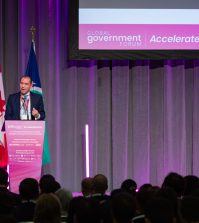
The new research summarises the findings of a survey of 228 Canadian public servants registered to attend Global Government Forum’s AccelerateGOV event, which took place in Ottawa in December 2025 and was attended by over 2,000 public servants. The report focuses on how to scale what works and overcome barriers to digital transformation and also draws on insights from panel sessions, presentations and discussions at the event.
Almost half (48%) of survey respondents characterised their organisation’s overall digital capability as ‘moderate’, with 15% saying it is high and 3% saying it is very high. A quarter (25%) characterised their organisation’s digital capability as low and 9% very low.
The area where public servants perceive their organisations as being most mature is technology infrastructure, followed by use of data and analytics, then digital service design and delivery, and digital leadership.
Asked what has been the most effective in enabling their organisation’s digital progress to date, survey respondents ranked the regular use of data and evidence to guide decision-making as the top factor, followed by modern and flexible technology platforms, then clear strategic direction and commitment from senior leaders. The next most effective drivers were collaboration across departments and agencies, partnership with external or academic organisations, and funding and procurement models that enable experimentation.
The biggest barriers to digital transformation are seen as budget and procurement constraints; legacy systems and integration challenges; and lack of clarity in roles or accountability for digital outcomes. Other barriers include a shortage of skilled staff; organisational culture and resistance to change; and complex or outdated regulations.
The report also explores technology infrastructure, data and AI, and people, skills and culture.
Read more: Relive all the sessions from AccelerateGOV 2025
Top priorities
Survey respondents ranked expanding the use of AI and automation as their top priority for the year ahead (64%), followed by upgrading or replacing legacy systems (44%), and enhancing data-sharing and interoperability (36%).
“When we bring our ideas and strengths together, we can create solutions none of us could build on our own,” Rochon wrote in the foreword, reflecting on the event. “That is how we improve, not by staying comfortable, but by pushing ourselves to approach challenges differently, with clarity, purpose, and a shared commitment to public value.”
“I encourage readers to reflect on these findings and consider how they can be applied within their own organisations, and how they might help inspire the next phase of our collective digital transformation,” he said.
Download the report: Accelerating government transformation: Takeaways from AccelerateGOV2025

About Sarah Wray
Sarah has over 15 years’ experience as a journalist with a specialism in the public sector and topics such as digitalisation and climate action. Sarah was formerly the editor of Cities Today and Smart Cities World, as well as a specialist video-based publication in the aerospace sector. She has also written for publications including Smart Cities Dive, Mobile Europe, Mobile World Live and Computer Weekly.

Related Posts