The economics of government innovation

By Andres Raieste, SVP, Global Head of Public Sector, Nortal
In public administration, innovation only matters if it improves outcomes. If a programme does not help to implement policy effectively, to use public resources responsibly and to maintain citizens’ trust in democratic institutions, it is not transformation. For senior leaders, the central question is therefore not how to innovate, but how to fix recurring bottlenecks at the lowest sustainable cost.
This is the premise of Nortal’s recent white paper, Government efficiency in the age of AI, which argues that true efficiency must be measured by how well services run, how reliably policies are executed and whether citizens trust the result.
Fiscal discipline sharpens priorities
Governments face tighter budgets and higher expectations. Defence spending is rising, demographics are tightening fiscal space and long-term liabilities are growing. At the same time, administrative complexity is increasing and policy cycles are accelerating.
Under these conditions, innovation cannot be justified by aspiration alone. It must demonstrate public value.
Before launching a new digital programme, leaders should be able to answer a few straightforward questions. Will it lower structural costs? Will it strengthen the government’s ability to execute policy across institutions? Will it reinforce trust and voluntary compliance? If the answers are unclear, the investment should be reconsidered.
Further, scarcity clarifies priorities. When resources are constrained, organisations simplify processes, remove duplication and focus on reforms that deliver measurable returns. In practice, innovation follows discipline.
But fiscal pressure alone does not define what should be optimised. To measure public value properly, governments must first decide what they are trying to improve: cost, execution or trust.
Efficiency in a democratic system
Efficiency in government is often interpreted narrowly as cost reduction. In democratic systems, it is broader and more structural. It concerns how effectively public resources and individual contributions are mobilised to maximise societal benefit over time.
In practice, three dimensions must be aligned:
- Operational efficiency – delivering services faster, at lower cost and with consistent quality.
- State capacity – the ability to design, implement and enforce policy effectively.
- Public trust – citizens’ confidence that institutions act competently, fairly and within the law.
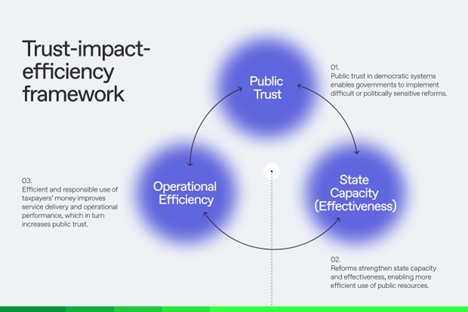
Figure 1: Framework to build efficient digital governments using democratic principles.
Public trust is important to implement reforms to strengthen policy outcomes and improve state performance. At the same time, when governments use public resources effectively and responsibly, trust tends to increase. This creates what is essentially a virtuous cycle between trust, efficiency and effectiveness.
These three dimensions therefore reinforce one another. Attempts to optimise one dimension in isolation rarely succeed. Sustainable improvement requires progress across all three areas.
What disciplined efficiency looks like
Governments that improve over time do not simply digitise services. They adopt a governing logic grounded in system-level efficiency. Three disciplines tend to distinguish those:
1. Strengthen state capacity through architectural design
State capacity is about the structural ability to execute decisions consistently across institutions. When governments optimise isolated projects, they may improve individual services while creating duplication, delays or conflicting data. A centralised solution can simplify one function while creating long-term bottlenecks, dependencies or hidden fragility.
Choices about system architecture determine where power sits and how risk accumulates. Highly centralised designs may simplify control, but they also concentrate vulnerability. Federated models distribute both responsibility and resilience.
Therefore, in the digital era, the way systems are built determines whether decisions can actually be carried out.
2. Trust lowers the cost of governing
Trust behaves like an economic variable. Where trust is high, voluntary compliance increases, administrative friction decreases and enforcement costs decline. Reforms move faster because institutions are perceived as legitimate and predictable. Where trust is low, systems compensate with additional controls, manual verification and defensive procedures, all of which increase cost and slow performance.
Trust must therefore be embedded into digital infrastructure. Citizens should have visibility into how their data is accessed and used. Algorithmic decisions should be auditable. Access to data should be limited strictly to legal mandates. Human oversight should remain clear where rights are affected.
Governments that treat trust as infrastructure rather than communication consistently achieve higher system-level efficiency.
3. Increase operational efficiency through disciplined automation
Operational efficiency improves when processes are clear, consistent and proportionately automated. Rule-based automation should be the default where legal conditions are well defined and data is structured. It enhances predictability, ensures equal treatment and allows full auditability.
Artificial intelligence adds value where complexity exceeds the ability to codify every condition in advance, for example, identifying patterns, detecting anomalies or supporting predictive decisions. However, AI amplifies the quality of the system beneath it. If processes are fragmented or poorly governed, AI scales inconsistency rather than efficiency.
Human oversight remains essential in decisions that affect rights and entitlements. Not because automation is inherently flawed, but because decisions that affect rights must be explainable to the people affected.
Efficiency must endure
Every efficiency decision carries trade-offs. Short-term cost reductions can undermine long-term adaptability if they create dependency, lock-in or reliance on a single vendor or platform.
System-level efficiency only holds if it survives technological change, fiscal pressure and geopolitical uncertainty. Modular design, open standards and strategic control over data and infrastructure preserve that flexibility. They allow governments to upgrade systems, introduce AI or change providers without disrupting core services.
As AI becomes embedded in justice, healthcare, taxation and security, the ability to evolve systems without shutting down services across government becomes a matter of national resilience.
Hence, resilience and sovereignty are not separate goals, they determine whether efficiency gains last.
Innovation follows discipline
Taken together, these disciplines describe a way of running government in the digital age. They align architecture with capacity, make transparency part of the system itself, apply automation proportionately and protect long-term adaptability.
When these conditions are met, measurable improvements follow: reduced administrative burden, faster policy execution, stronger compliance and greater public confidence.
Innovation, in that context, is not pursued as a headline. It is the consequence of careful choices about how systems are built and governed.
Learn more
These themes, along with a practical maturity model and recommendations for policymakers, are explored in Government Efficiency in the Age of AI: Toward Resilient and Efficient Digital Democracies, co-authored by Dr. Mihkel Solvak, Dr. Ott Velsberg and Dr. Keegan McBride, with review contributions from Dr. David Ronfeldt.
Download the paper:
https://nortal.com/insights/paper/government-efficiency-in-the-age-of-ai
Join the discussion
Andres Raieste will speak at the Global Government Forum closing session, “Ready for change: What the future of government looks like,” alongside Peter Pogačar, Director General, Public Sector Directorate, Ministry of Public Administration, Slovenia; Harri Martikainen, Director General of the Government Strategy Department, Prime Minister’s Office, Finland; and Emily Middleton, Interim Director General for Digital Transformation, Government Digital Service, United Kingdom.

About Partner Content
This content is brought to you by a Global Government Forum, Knowledge Partner.

Related Posts