UK Cabinet Office chief flags missions on civil service pay, digital tools and training
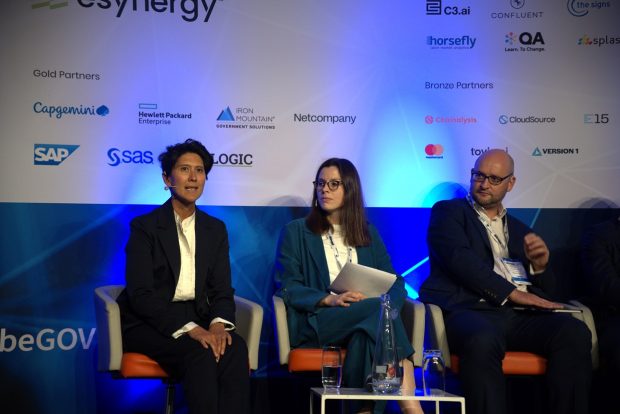
The chief operating officer of the UK civil service has set out her “big missions” to reform pay, tools and training for civil servants, signalling that major changes are on the way.
Cat Little, who took up her roles as COO and permanent secretary of the Cabinet Office in April, told an audience of civil servants at Public Service Data Live on Thursday 19 September: “I’ve come into this job and looked at the state of the civil service and where we are, and we’re saying there are three really big things we’ve got to sort out.”
First, she said, “there is a whole set of issues around pay which you do not need me to tell you about. You feel it every single day.”
“The second area is to make what we do digitally enabled,” she continued. “So the vast majority of the civil service are in operational delivery, and they haven’t got the tools to do their job; it’s that simple. And so we’ve got to really build data and digital delivery into the way in which the civil service delivers services for citizens.”
“And then the final thing is to get our learning and development into much better order,” said Little. She added: “I think we need a core curriculum. We need to own it. I should be coaching future generations in the skills that I’ve learned. You should be bringing on the next generation. I think the model of outsourcing and delivering it through third party providers is not a great way to do it.”
These reforms represent “the three pillars of what we’re going to be looking at in the future, and data and digital technology [are] right at the heart of it”, she said.
Read more from Public Service Data Live: UK digital chiefs emphasise the need for data foundations to unlock government transformation
Skills and secondments
Speaking during a panel discussion, Little also suggested changes to civil service recruitment and deployment. “One of the things we’re looking at is whether we could have a single skills record for every single person in the civil service, so that we can better match people up to jobs that are available,” she said. “Wouldn’t it be great if you could go on Civil Service Jobs and go: ‘Here’s my skills record. Tell me which jobs match my skills.’? And instead of going through an application process, as an employer, I could just go: ‘I can see that there are 400 people with those skills. I better go and ask them if they would like to come and work with us’.”
Another idea that Little is exploring, she said, is modelled on a Singaporean programme that permits civil servants to take up six-month secondments on projects that enthuse them. “We could have a mutual agreement in the civil service that people could go: ‘Just for six months, I want to go and do something’,” she suggested.
To realise such reforms, Little argued that the “hierarchical, quite rigid structures of the old-fashioned civil service, I’m afraid, have to change, because they’re not fit for purpose for what we do as a project-based, multi-disciplinary organisation”. And she emphasised the need to make rapid progress on digital and data technologies, telling the audience at Public Service Data Live: “You guys harness the most powerful and valuable tool that we have got in the future of government, and it is so exciting that we are bringing policy and delivery together in DSIT.”
From the centre to the Middleton
This last comment refers to the movement of government’s central digital operations – its Central Digital and Data Office (CDDO), the Government Digital Service, and the Incubator for Artificial Intelligence – from the Cabinet Office to the Department for Science, Innovation and Technology, where they now sit alongside the teams handling wider government policies on digital and data issues.
The move represents “an effort to try and unite all those different efforts and capabilities in the digital transformation of public services in one home, in one department, and also to make the most of all the synergies that exist with different kinds of tech policy expertise elsewhere in DSIT”, Emily Middleton, DSIT’s director general of digital centre design, told the audience at the panel discussion.
Middleton, who left consultancy Public Digital to take this temporary civil service role after the July general election, explained that “the idea is really to help drive forward some of those bigger digital changes that we need to overhaul people’s experience of interacting with government so that it can be more personalised, more convenient, and save people time and effort”.
Data-driven missions
Middleton is currently “working through what the design of this looks like – thinking about how this new, empowered digital, data, technology, AI centre can really help drive collaboration, not just within central government, but also more widely with others across the economy and at different levels of government and public services”.
Middleton emphasised that the digital centre’s shift away from the Cabinet Office has not deprived it of the influence required to promote reform. “This is very much still a very close partnership with the Cabinet Office and with Treasury to make sure that everything that we need to undertake, the important system reform pieces that the CDDO has started and been working on, that we have all the right levers to do that,” she said.
The civil service’s growing data management capabilities have been put at the heart of delivery on the government’s “five missions”, commented Little: performance against its goals will be measured and tracked over time. “Every single Mission Board has a data dashboard,” she said. “It has evidence and trend analysis to help us understand what the problems are; and crucially, in setting that long-term vision, we’re saying there has to be a long-term data metric that we are monitoring.”

About Matt Ross
Matt is Global Government Forum's Contributing Editor, providing direction and support on topics, products and audience interests across GGF’s editorial, events and research operations. He has been a journalist and editor since 1995, beginning in motoring and travel journalism – and combining the two in a 30-month, 30-country 4x4 expedition funded by magazine photo-journalism. Between 2002 and 2008 he was Features Editor of Haymarket news magazine Regeneration & Renewal, covering urban regeneration, economic growth and community development; and from 2008 to 2014 he was the Editor of UK magazine and website Civil Service World, then Editorial Director for Public Sector – both at political publishing house Dods. He has also worked as Director of Communications at think tank the Institute for Government.