UK peers urge tighter AI regulation for transparent and safe adoption in government
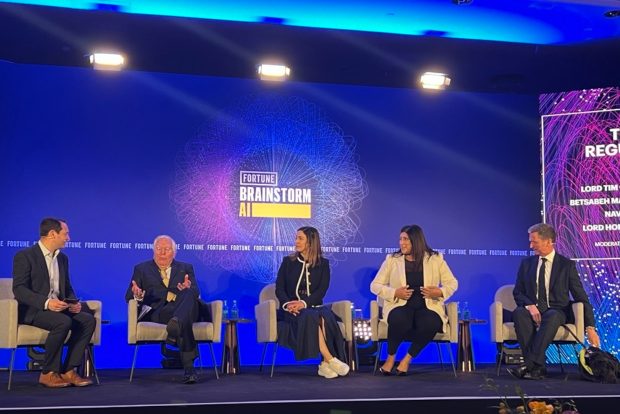
A UK peer who has proposed new legislation to regulate the use of artificial intelligence has said that human-centred design and management needs to be placed at the heart of how the technology is used in government.
Lord Chris Holmes of Richmond, who has promoted a private members bill seeking to create a new AI Authority to better align the work of regulators on AI, also said that civil servants needed access to more training as they get to grips with the technology.
Speaking at the Brainstorm AI conference in London on 6 May, Holmes, a Conservative Party peer, said that more needed to be done to strengthen algorithmic transparency.
“There have been examples [of AI adoption] where it’s been, if you will, ‘rush and grab’, and you’ve seen some very, very negative and unfortunate results,” he said in response to a question from Global Government Forum.
“If you have that, it makes that sense of public trust understandably even harder to start to come towards.”
His Artificial Intelligence (Regulation) Bill states that AI regulation should focus on five principles: safety, security and robustness; appropriate transparency and explainability; fairness; accountability and governance; and contestability and redress.
The planned legislation also sets out that any business which develops, deploys or uses AI should be transparent about it, test it thoroughly and transparently, and comply with all applicable laws, including in relation to data protection, privacy and intellectual property.
Although the bill is unlikely to become law because it is not sponsored by the government, Holmes said the aim was “to ensure that whichever part of society, whichever part of the economy you come across AI, you can have that consistency of approach” in how it is deployed. “If you just left it to existing regulation, the chances of having that clarity, certainty, consistency, which leads to the confidence to act, would be extremely unlikely.”
Speaking alongside Holmes at the conference, Lord Tim Clement-Jones, a Liberal Democrat peer and spokesperson for the digital economy in the House of Lords, said that transparency was currently lacking in the use of AI tools in government.
“There have been many cases where the government’s use of things like automated decision-making have been highly problematic, both in immigration and in social security.”
He added that while there was an “algorithmic transparency recording standard” planned for implementation across central government, local government lacked similar assurances.
“[The standard] doesn’t cover a register of algorithms used in government, and it doesn’t provide mechanisms for complaints and redress for the ordinary citizen,” he said.
Read more: UK government issues AI playbook to repair ‘broken public services’
Beyond Bletchley
Asked about the adequacy of AI regulation in the UK, Clement-Jones said he believed new legislation would be needed to protect the country and certain sectors of the economy from emerging forms of AI that are not covered by current measures.
“The idea that we’ve got enough central coverage of this is wrong,” Clement-Jones said.
“There are many sectors that aren’t going to be covered by the regulator, and there are things like transparency, accountability, clear liability [that are] not there in our current laws.”
He added: “All our current government in the UK is planning to do is to have some sort of incorporation of what we call the Bletchley Declaration applied to generative AI. Well, there are many other forms of AI which need regulation.”
The Bletchley Declaration was signed by 28 countries and the European Union and published on the opening day of the first global AI Safety Summit held in Bletchley Park in the UK in November 2023.
The declaration, which was signed by the previous Conservative government for the UK, stated that “for the good of all, AI should be designed, developed, deployed, and used, in a manner that is safe, in such a way as to be human-centric, trustworthy and responsible”.
It set an agenda for addressing frontier AI risk with a focus on identifying AI safety risks of shared concern, and building a shared scientific and evidence-based understanding of these risks. It also promoted the building of respective risk-based policies across countries to ensure safety in light of such risks, and collaboration as appropriate.
However, following the change of administration in the US, at this year’s AI Action Summit in Paris in February this year, US vice president JD Vance said that stringent regulations on AI could “kill a transformative industry just as it’s taking off”, adding that the Trump administration wanted to see “pro-growth AI policies” from other countries.
Holmes challenged the idea that further regulation would strangle AI innovation at a crucial stage of its maturity.
“This sense that you can either have regulation or innovation is complete nonsense, because if you have right-size regulation, it’s good for the innovator, good for the investor, good for the citizen [and] good for the consumer,” Holmes said.
More on AI guidance in government:
Trump administration sets guardrails for AI use and acquisition within government agencies
Canada launches first AI strategy for federal public service
New Zealand government forges path to responsible AI with new framework

About Jack Aldane
Jack is a British journalist, cartoonist and podcaster. He graduated from Heythrop College London in 2009 with a BA in philosophy, before living and working in China for three years as a freelance reporter. After training in financial journalism at City University from 2013 to 2014, Jack worked at Bloomberg and Thomson Reuters before moving into editing magazines on global trade and development finance. Shortly after editing opinion writing for UnHerd, he joined the independent think tank ResPublica, where he led a media campaign to change the health and safety requirements around asbestos in UK public buildings. As host and producer of The Booking Club podcast – a conversation series featuring prominent authors and commentators at their favourite restaurants – Jack continues to engage today’s most distinguished thinkers on the biggest problems pertaining to ideology and power in the 21st century. He joined Global Government Forum as its Senior Staff Writer and Community Co-ordinator in 2021.


Related Posts