Why governments must ‘grab the nettle’ on digital capability

The first in a series of extracts from Global Government Forum’s new study on future-proofing digital capability examines why governments need a clearer picture of the people, skills and suppliers that underpin digital delivery
Governments need to move from a reactive, siloed approach to managing digital capability in a system-wide way, according to a new study from Global Government Forum (GGF).
The Future-proofing government digital capability study, led by Kevin Cunnington, executive advisor at GGF and former director general of the UK Government Digital Service, explores how government organisations can ensure they have the right capability in place to deliver on their digital visions.
Based on interviews and a roundtable with over 20 digital leaders from around the world, including the UK, the US, Canada, Singapore, Australia and New Zealand, the report identifies six common foundations that underpin digital capability across governments, and how to make sure these foundations are resilient in a fast-changing environment.
Cunnington writes in the foreword: “The ability to meet today’s expectations and capitalise on tomorrow’s opportunities depends on capability – the right people, skills and partners to deliver. Governments need a clear understanding of their digital service priorities; strong in-house technical capability to retain control; a workforce that is confident in using digital tools and approaches; and a strategic approach to engaging and shaping the supplier ecosystem. They also need to ensure citizens are well-equipped to adopt digital services.”
He added: “Achieving better capability depends on answering the questions: What does ‘good’ look like? And how do we measure it? Through Global Government Forum’s advisory and training work with governments, we see first-hand how difficult it remains to answer these questions in a consistent, system-wide way. I believe that this needs to change, and that governments need to start treating capability as something they actively design and measure.”
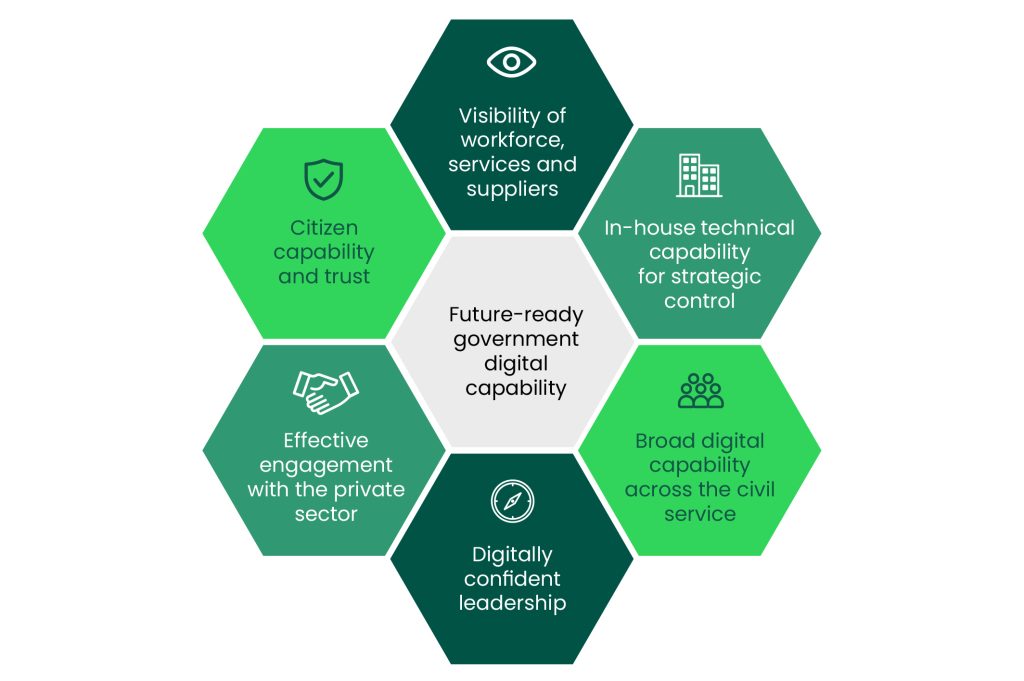
On that theme, this extract explores the first pillar: visibility of workforce, services and suppliers.
Without understanding the resources that are available across workforce, services and suppliers, governments can’t effectively implement their digital strategies, make the most informed decisions, or plan for the future. But this holistic view is something that many systems still lack.
Download the report: Future-proofing government digital capability: Six foundations for success
Workforce visibility
While some governments have a clear view of how many digital staff they have and where, several leaders highlighted weak visibility of the digital workforce and skills base as a fundamental constraint. Governments may be increasing headcount or investing in training but often lack a clear picture of what skills they already have in place and where those skills are located.
In some cases, this is due to outdated administrative systems. One interviewee described HR classification systems as “somewhat arcane”, leading to misleading records.
Definitions also vary. Some governments rely on external professional groupings or union classifications as proxies for digital roles, but these are inconsistent, with organisations “trying to vie for the definition of digital worker”. As AI expands the range of people engaging in digital tasks, this ambiguity is increasing: “Everyone can advocate [that they’re] a specialist. It’s skewing the landscape,” one interviewee said.
Some governments have made progress through standardised frameworks. The UK’s Government Digital and Data Profession Capability Framework, for instance, provides a fixed set of approved digital job roles, and employees can only be assigned to these roles if they demonstrate the required competencies.
Others have adopted tools such as the globally acknowledged Skills Framework for the Information Age (SFIA), but use is often voluntary, limiting the ability to provide a comprehensive picture.
A clear trend is a shift towards competency-based frameworks. This means instead of defining people strictly by job titles or roles, governments instead identify skills and capabilities across different domains, such as systems engineering, programme management or data analysis. Individuals are tagged with these competencies, and roles are tagged in the same way to help ‘matchmake’. This creates a common framework, allowing skills to be recognised as portable rather than tied to a single department or function.
However, significant challenges with digital workforce visibility remain. As one interviewee put it: “The baseline just isn’t there”. Many governments still rely on manual processes such as periodic surveys and “very heavy Excel spreadsheets”, requiring substantial effort to cleanse and standardise data.
Frequent staff movement compounds the issue. Without more robust systems, it becomes “impossible” to track how capability shifts over time.
Turning strategy into delivery: Find out more about Global Government Forum’s training and advisory services
Service visibility
While some countries have moved to almost 100% digital provision of services or have ambitions to do so, many are still struggling to gain a clear view of their digital services and therefore the required resource.
Some still lack a clear count of the services their government operates and others described disagreements over what should qualify as a digital service, with examples ranging from end-to-end platforms to basic interactions such as email communication or downloadable PDFs.
Without a shared understanding of what services exist or are planned and common definitions, it’s difficult to effectively determine what capability is required to build, maintain and improve them.
Some also highlighted duplication and overlap across agencies, which further complicates efforts to build a coherent system-wide view.
Governments are adopting different approaches to this. In the UK, services associated with GOV.UK are subject to the Service Standard, which provides consistent criteria for service development and assessment across government.
Others are approaching the issue by identifying the most-used services or key life events and mapping these to digital services, with clear roadmaps for improvement.
Supplier visibility
Visibility challenges also extend beyond the internal workforce and services to the external market.
Several interviewees reported that they lacked a clear overview of their supplier landscape. One noted bluntly: “I can’t tell you how many suppliers we have.”
In many government systems, departments retain significant discretion over procurement, resulting in fragmented supplier ecosystems and limited central oversight. This makes it difficult to assess the extent of outsourcing, identify areas of over-dependence, or manage supplier relationships.
Some also described complex delivery models in which smaller firms pitch for work before partnering with larger providers, leaving governments without clear visibility and struggling to “wrap our arms around it”.
This lack of insight has direct implications for capability. Without understanding how much work is delivered externally, and what is available in the market, governments cannot determine what capability they need to retain internally or how this needs to shift over time.
“I can’t tell you how many suppliers we have.”
Some governments are now strengthening visibility of their supplier landscape as a foundation for more effective market engagement, such as implementing more centralised oversight of IT procurement.
Facing the future
Without a clear baseline across people, services and suppliers, governments are forced into reactive decision-making. Recruitment responds to immediate gaps rather than long-term needs, training is deployed without a clear understanding of where capability is strongest or weakest, and supplier engagement evolves in silos rather than as part of a coherent strategy.
Even where progress is being made, visibility often remains partial, inconsistent or slow to update.
Leaders also express concern that strategic foresight and planning are too limited. While services are being digitised, AI adopted, and user journeys redesigned, “what’s not happening in parallel is a complete rethink about how that is supplemented”, one interviewee commented.
“The second thing is the actual technology,” they added. While civil servants can be trained in data and AI, “what’s not happening is a wider, more strategic identification of which jobs will be enhanced by AI, which jobs will be changed by it, and which jobs actually could be removed altogether”.
“Everybody agrees it needs to be done but there’s a degree of discomfort in actually grabbing that particular nettle and doing something with it,” they said.
“There’s a reason why transformation happens in some governments.”
The issue becomes even more pressing with the advent of agentic AI, which brings together AI chatbot capabilities with process automation to create tools that can carry out tasks typically done by humans.
One leader suggested that the strategic future focus should be led from the centre of government, and soon. “I think you need to get a type of personality in the centre to do this, a really entrepreneurial civil servant,” they said, noting that: “There’s a reason why transformation happens in some governments.”
The study explores each of the six foundations in depth and outlines how they can strengthen each of them.
Visibility of workforce, services and suppliers: Building future-ready digital capability
- A clear, system-wide baseline of capability. As digital services expand, governments will need an increasingly complete and accurate view of their workforce, services and suppliers.
- Shared definitions of roles, skills and services. As boundaries between digital and non-digital work blur, common frameworks will be critical to maintaining clarity and coherence across the system.
- Visibility of both internal and external capability. As governments seek to work with suppliers strategically, a clear understanding of external capability and use will be crucial.
- Dynamic insight. As technologies such as AI rapidly reshape roles and skill requirements, static workforce data will quickly become outdated.
- A joined-up, forward-looking view of capability. Governments will need to move beyond reactive responses and pay more attention to how capability needs will evolve over time.
GGF will now take the collaborative opportunities identified in this report forward – if you’d like to be involved, get in touch by emailing [email protected] so we can structure the work to be as useful as possible.

Participants in the study were as follows (job titles reflect those at the time of interview/roundtable participation):
- Dr Subho Banerjee, deputy commissioner, head of the Australian Public Service Academy and capability, Australian Public Service Commission
- Gregory Barbaccia, federal chief information officer, Office of Management and Budget, United States
- Thomas Beautyman, deputy director of government digital capability, Department of Science, Innovation and Technology, United Kingdom
- Dominic Chan, assistant chief executive, product, and chief information officer, GovTech Singapore
- Marie-Chantal Girard, president, Public Service Commission, Canada
- Shafiqa Dawood, chief digital and technology officer, Department for Education, United Kingdom
- Wolfgang Ebner, federal chief digital officer, Austria
- Richard Gevers, head of service design and delivery, Digital Services Unit, South Africa
- Luukas Ilves, former chief information officer and undersecretary for digital transformation, Government of Estonia, and advisor to the deputy prime minister and minister of digital transformation, Ukraine
- Valeriya Ionan, advisor to the deputy prime minister of Ukraine on innovation, digitalisation and global partnership and former deputy minister of digital transformation, Ukraine
- Birna Íris Jónsdóttir, CEO, Digital Iceland, Iceland
- Paul James, government chief digital officer, New Zealand
- Romina Kostani, deputy general director of the National Agency of Information Society, Albania
- Chris Leck, group chief technology officer, Public Sector Science & Technology Policy & Plans Office, Prime Minister’s Office, Singapore
- Barry Lowry, government chief information officer, Ireland
- Lauri Luht, government chief information officer, Estonia
- Dominic Rochon, government chief information officer, Canada
- Haseley Straughn, digital development policy coordinator, Ministry of Industry, Innovation, Science and Technology, Barbados
- Jaanus Vant, AI and data strategy coordinator, Ministry of Economic Affairs and Communications and Ministry of Justice, Estonia
- Paul Wagner, chief executive officer, Canadian Digital Service, Canada
- Vicky Wang, senior director, digital workforce transformation, Smart Nation, Singapore
- Claire Wraith, head of strategic workforce and transformation, Government Digital Service, United Kingdom

About Sarah Wray
Sarah has over 15 years’ experience as a journalist with a specialism in the public sector and topics such as digitalisation and climate action. Sarah was formerly the editor of Cities Today and Smart Cities World, as well as a specialist video-based publication in the aerospace sector. She has also written for publications including Smart Cities Dive, Mobile Europe, Mobile World Live and Computer Weekly.