10-year health plan for England bets big on digital

The long-awaited 10-Year Health Plan has been published, setting out an ambition for the National Health Service (NHS) in England to become “digital by default”.
“Modern technology has given us more power over our everyday lives. But that same scale of change has yet to come to the NHS,” the government said. “This plan will take the NHS from the 20th-century technological laggard it is today, to the 21st-century leader it has the potential to be.”
The 168-page Fit for the Future plan reiterates the aim to make three major shifts for the health service – from hospital to community, analogue to digital, and treatment to prevention.
A ‘doctor in your pocket’
The government said it wants to create “the most digitally accessible health system in the world” and will make the existing NHS App the front door to the NHS. Developments will enable patients to book, move and cancel their appointments, and to manage communications, through it. The app will also use AI to provide instant advice for patients who need non-urgent care.
There are also plans to develop a Single Patient Record to prevent people from having to repeat the same information to health professionals.
“The NHS App will become a ‘doctor in your pocket’, bringing our health service into the 21st century,” said health and social care secretary Wes Streeting.
“The 10-Year Health Plan will keep every patient fully informed of their healthcare and make using the NHS as easy and convenient as doing your banking or shopping online.”
The goal is to replace two-thirds of outpatient appointments – which currently cost a total of £14bn (US$19bn) a year – through automated information, digital advice, direct input from specialists, and patient-initiated follow-ups via the NHS App.
Plans are also detailed to introduce single sign-on for staff and to scale the use of technology like AI scribes to free up staff time.
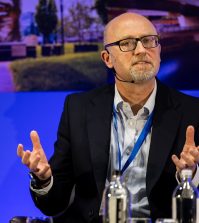
Ming Tang, interim chief digital and information officer at NHS England, said: “The plan sets bold ambitions – not just to digitise services, but to redesign care around people’s lives.
“From the vision of a Single Patient Record to the transformation of the NHS App into a true health companion, maximising the FDP [Federated Data Platform] which is helping us join up data to better plan, manage and coordinate the delivery of care.
“We’re also laying the foundations to harness AI safely, strengthen data sharing, and unlock health data for research that brings benefits back to the public faster.”
“There’s a lot to do to deliver this transformation – but [the plan] marks a pivotal moment,” added Tang, who is a speaker at Global Government Forum’s Public Service Data.AI event in September. “Digital and data are central to the NHS of the future and the three shifts of healthcare, allowing us to improve the health outcomes of the nation.”
Neighbourhood health hubs
The government also announced plans for a Neighbourhood Health Service where a new network of neighbourhood health centres will be set up to shift care out of hospitals and into the community. The centres, which will eventually be open 12 hours a day, six days a week, will be staffed by a mix of GPs, nurses, social care workers, pharmacists, mental health specialists and other medics, and will also offer services like debt advice, employment support, and help with stopping smoking or weight management.
Sir Jim Mackey, chief executive of NHS England, said: “The neighbourhood health service is a huge opportunity for us to transform how we deliver care over the next decade – starting right on people’s doorsteps.
“By bringing together a full range of clinicians as one team, we can deliver care that’s more accessible, convenient and better for patients, as well as reducing pressures on hospitals.”
New operating model
Under the plan, the government said there will be a new “NHS operating model”, to deliver a more diverse and devolved health service.
“Today, power is concentrated in Whitehall, rather than distributed among local providers, staff and citizens,” it said.
As previously announced, NHS England will be merged with the Department of Health and Social Care, with a 50% reduction in central headcount.
The government will introduce a system of “earned autonomy” and where local services consistently underperform, step in with a new “failure regime”. The priority will be to address underperformance in areas with the worst health outcomes, with the ambition for high autonomy to be the norm across every part of the country within a decade.
The plan details a goal to “reinvent the NHS foundation trust (FT) model for a modern age”. By 2035, the ambition is that every NHS provider should be an FT with freedoms including the ability to retain surpluses and reinvest them, and borrow for capital investment. FTs will be able to use these flexibilities to improve population health, not just increase activity. The best NHS FTs will be able to hold the whole health budget for a defined local population as an integrated health organisation (IHO). The intention is to designate a small number of these IHOs in 2026, with a view to them becoming operational in 2027 and that over time they will become the norm.
The NHS will also trial new “patient power payments”, where patients are contacted after care and given a say on whether the full payment for the costs of their care should be released to the provider.
Read more: UK government launches GOV.UK digital services app for smartphones
Delivery
The Health Service Journal (HSJ) reported that the plan was published without an intended chapter on delivery. A draft of the 10-Year Plan seen by the HSJ included an index page which listed a ninth chapter entitled ‘Change begins’. The published plan contains just eight chapters plus an introduction.
Jim Mackey told the HSJ that the plan was intended to create “energy and enthusiasm” and that detailed frameworks and guidance on several key areas would be published before winter.
Reactions
Dr Jennifer Dixon DBE, chief executive of the Health Foundation think tank, said: “We welcome many of the changes in the plan – more integrated services, boosting primary and community care, harnessing innovation and technology, reducing health inequalities – but these are not new ideas and questions remain about how they will be implemented and whether they will be backed by sufficient resources.
“Without investment and reform of the threadbare social care system, or co-ordinated action to address the wider social and economic causes of ill health, the plan remains largely a vision for the NHS, rather than a plan for rebuilding the nation’s health. The government’s health mission – which promised just such an approach – is currently missing in action and in urgent need of resuscitation.”
She added that: “Technology brings hope for the future – and the plan places big bets on new innovation and an expanded role for the NHS App in delivering the government’s shift from analogue to digital. Used effectively, the NHS App has the potential to empower patients and support them to better manage their health, make processes more convenient and improve efficiency. But it is just one part of more complex changes in services and behaviours needed to bring the NHS into the 21st century – changes that fundamentally depend on the hard work and dedication of NHS staff, working with patients and the public.”
Read more: Foundations first: UK data leaders on delivering the government missions
Sarah Woolnough, chief executive of The King’s Fund, said: ‘While the possibilities of AI are exciting and present an opportunity to improve patient outcomes and staff experience, there is also an urgent need to get the basics right first. Much of the health service is plagued by basic IT woes and outdated equipment.
“The plan says that patient use of the NHS App and AI for staff will save billions by cutting paper and reducing human effort. The plan includes proposals for how technology will improve IT so staff don’t have to spend half an hour trying to log on to their computers before they deliver clinical care. But historically announcements on NHS tech have been big on promise but lacking in delivery as money has been diverted to other areas.
“Strengthening the NHS App will help more people to manage their health better, but the NHS has been trying to embrace new technology for years and the clear lessons from the past are that the benefits of new technology will not be realised unless staff and patients are involved in design and implementation of how it is rolled out.”

About Sarah Wray
Sarah has over 15 years’ experience as a journalist with a specialism in the public sector and topics such as digitalisation and climate action. Sarah was formerly the editor of Cities Today and Smart Cities World, as well as a specialist video-based publication in the aerospace sector. She has also written for publications including Smart Cities Dive, Mobile Europe, Mobile World Live and Computer Weekly.

Related Posts