Canadian public servants invited to submit ideas for data and AI innovation

The Canadian Public Service Data/AI Challenge has already carried one idea through into a brand new public service, and its second set of winners are now entering the delivery phase. As the Challenge opens for a third round of entries, top data leaders are urging public servants to put forward their ideas for how government could make better use of data
Top Canadian data leaders have urged public servants to send in their ideas for how government could make better use of data, inviting them to enter the 2024-25 Public Service Data/AI Challenge – which identifies promising ideas for data-based reforms and services, then creates dedicated teams to move them into implementation.
“Think about all the things that you could do if you use data in a different way, then go for it! You don’t need to have all the answers or a fully-baked idea to enter,” said Elise Legendre, chief data officer of Agriculture and Agri-Food Canada (AAFC), who’s been a member of the Data Challenge judging panel since its launch in 2022. “You just have to have a good idea: put your name in and see where it goes!”
Canada’s chief data officer Stephen Burt, one of the programme’s three ‘champions’, added: “This is a fantastic way to develop your own skills and career while improving the lives of Canadians.
“Those putting forward the best ideas will get to carry them all the way through into delivery, like our first year’s winners – whose concept is now up and running as the Agpal chatbot: the Government of Canada’s first public-facing generative AI tool.”
“Even if you don’t have your own idea for how to better use data, you can still get involved: our teams need people with all kinds of skills, from a wide range of organisations and at all levels of seniority,” Burt continued. “It’s a brilliant opportunity to work in an interdisciplinary, cross-departmental team with people from across the public service, while learning how to develop and introduce digital technologies. These are going to be crucial skills over the coming years.”
Under the Data/AI Challenge, any Canadian federal public servant can submit an idea for how to improve government’s use of data – perhaps by linking two datasets to improve services, creating a data dashboard to improve decision-making, or applying new technologies such as generative AI. The programme’s partners – Statistics Canada, Natural Resources Canada (NRCan) and Global Government Forum – then longlist the most promising ideas, building teams with the right skills and contacts to develop each concept.
This is not just a programme for data professionals, said Erica Ren, chief data officer at Immigration, Refugees and Citizenship Canada and another Data Challenge judge. “A lot of the successful candidates aren’t data scientists,” she said, explaining that the teams need a range of capabilities – such as policy, communications and project management – and connections into all the departments relating to their idea.
Previous winners
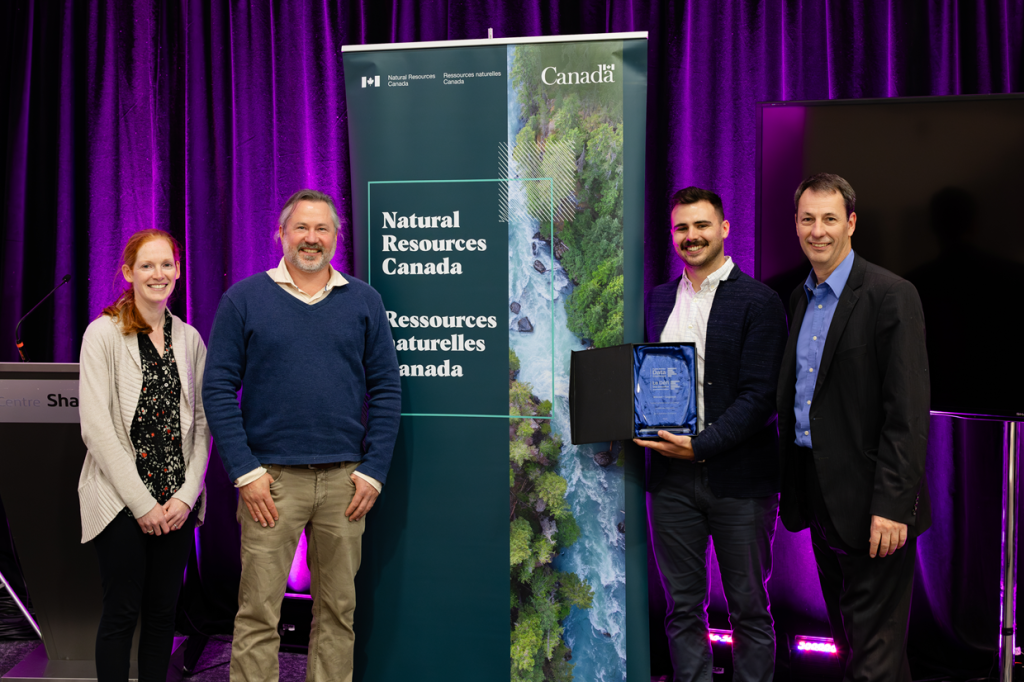
After an initial research and development phase, the longlisted teams pitch their ideas to a judging panel of senior data leaders. About half are shortlisted, and embark on further development work before meeting the judging panel again at the final – which was held this year at the AccelerateGov conference in Ottawa.
There, the top prize went to a team that aims to combine data held in two separate NRCan datasets to understand how money spent under the Green Homes programme has improved domestic energy efficiency – dramatically improving the information available to public funders and homeowners on how best to cut energy bills and carbon emissions. Receiving two complimentary ideas on this topic – from Jessica Heiss, a housing industry officer, and senior engineer Lucas Coletta – the Data/AI Challenge team had combined them, then brought in people with relevant skills and connections.
“Congratulations to the winning team,” Burt said at AccelerateGov. “Your work demonstrates the incredible potential of data to solve real-world problems. I’m looking forward to working with you on how this moves into reality.”
The chief data officer promised to help all the finalists to move their ideas forward, saying: “I’m going to be reaching out to you through my office for some meetings with myself, as well as with André Loranger, the chief statistician, to have a bit of a discussion about how we help you bring your ideas into reality as well – because they were all great. I think there’s lots in there that we can continue to push all the way through.”
This year’s winning team is now working on taking its idea forward. Meanwhile, Canadians are already benefiting from the winning idea from the Data/AI Challenge’s first year of operation. AAFC’s AI-powered chatbot, Agpal, was born of an idea submitted by policy analyst Jay Conte. After his team won the Challenge in 2023, they were supported to carry their idea through into implementation.
In its third year of operation, the programme has added AI to its title – making very clear the government’s keen interest in this emerging technology: both previous winners have involved applying AI. However, ideas need not include the application of AI in order to enter – or to win – the Challenge: all entries are scored against the judging criteria, which shape the judges’ decisions.
For more information on the Public Service Data/AI Challenge, and to apply to enter, visit the website. You can also learn more about the Challenge – and read advice from previous winners and judges – in our article on the development of Agpal

About Matt Ross
Matt is Global Government Forum's Contributing Editor, providing direction and support on topics, products and audience interests across GGF’s editorial, events and research operations. He has been a journalist and editor since 1995, beginning in motoring and travel journalism – and combining the two in a 30-month, 30-country 4x4 expedition funded by magazine photo-journalism. Between 2002 and 2008 he was Features Editor of Haymarket news magazine Regeneration & Renewal, covering urban regeneration, economic growth and community development; and from 2008 to 2014 he was the Editor of UK magazine and website Civil Service World, then Editorial Director for Public Sector – both at political publishing house Dods. He has also worked as Director of Communications at think tank the Institute for Government.