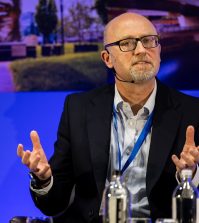
Delivering a different kind of service: Five minutes with Martin Waudby, chief data officer, London Borough of Camden

This interview with Martin Waudby, chief data officer of the London Borough of Camden, is part of a ‘Five minutes’ series featuring speakers from Public Service Data.AI, taking place in London on 18 September 2025.
In it, he discusses why it’s important not to succumb to AI “over-hype”, how to steer services towards better outcomes through predictive models, and a missed career as a planet detector.
What are you most interested in discussing at Public Service Data.AI 2025?
It’s listening to other departments’ stories that really interests me, across a range of topics. But, if we must get specific, the hot topic is AI adoption. Of particular interest to me is ensuring we don’t succumb to over-hype and we take a practical approach to ensure we take advantage of the potential – and also have suitable guardrails in place to ensure consistency, reliability, security, transparency, reproducibility and accountability.
At the end of the day, AI is just mathematics.
Waudby will be a panellist in the session ‘Opening up about data and AI to build trust’ at Public Service Data.AI, alongside Dr Amanda Svensson, deputy director of applied data & insight at the UK Government Communication Service; Sue Bateman, chief data officer at the UK Department for Environment, Food and Rural Affairs; and Dr. Iliya Peter Nickelt, chief data scientist at the German Federal Ministry for Economic Cooperation and Development.
Find out more and register to attend the event for free here.
What barriers or challenges have you overcome in your career?
In my working life I’ve faced bullying, disability discrimination, unfairness. While these do cut deeply, they are thankfully infrequent. Self-imposed barriers are mostly about imposter syndrome and confidence – not my confidence in myself, but my confidence that others have confidence in me. I’ve had periods where my mental health hasn’t been great too.
What more do you want to achieve before you retire?
In Camden, I really want us to deliver a different kind of service. One where we can steer services to better outcomes through predictive models, where there are long term benefits and where you can measure the outcome. In the public sector there have been loads of good examples emerging, but it seems we struggle to operationalise at scale. To me this is what “rewiring government” means.
What is the best piece of advice you’ve been given in your working life?
It wasn’t advice, it was a director general role-modelling a learning mindset naturally in a small but crucial meeting. They were reflecting on a recent difficult experience and what they might learn from it. That really drove the point home and really inspired me to fully embrace the potential of a learning mindset.
What advice would you give someone starting out in the public sector?
As you embark on your journey, pause and reflect on the journey you’ve taken from time to time. Learn from the experiences. I mean really learn. Don’t just understand why something happened but think about what you need to do, or how you need to adapt, or what you need to adopt as part of your toolbox.
Which country’s government department or agency are you most inspired by and why?
As a former employee, HM Passport Office still inspires me and it is my ‘go to’ for what good looks like for large scale transformation. I’m still awe-inspired by how we managed to pivot from a programme focused on scaling to more use cases, to one focused on coping with volume in the aftermath of COVID-19.
Are there any projects or innovations in the UK that might be valuable to your peers overseas?
Camden Data Charter, our guiding principles agreed with residents is already recognised internationally and it features in the UK’s Blueprint for Modern Digital Government for its transparency and accountability. It is just that, essential to transparency and accountability – so important for widespread adoption of AI-based technologies and more importantly trust in institutions.
If you didn’t do your current job, what would you do for work?
As a youngster I always want to be an astrophysicist and do planet detecting. But, I was a mediocre physics graduate and went travelling instead, and never quite got back to the country I grew up in.
What is your most treasured possession?
A digital SLR camera, which is the first thing I pack when going on holiday or go travelling.
What is your dream holiday destination?
Hard to say really because there are so many parts of the world to explore and I’ve done my dream destination, which was Antarctica. Going forward I want to explore Asia more (Bhutan, Nepal, Japan, Cambodia, the list goes on). I’m not a five-star traveller, I’m more than happy to rough it.
Public Service Data.AI
The Public Service Data.AI annual conference, held in London, will hear from leaders from across the UK government and wider public sector, as well as from other countries and international organisations, on how to improve the way data and AI are used in the public service.
Sessions will include a keynote address from Lindsay Mason, chief data officer of the UK government, to kick off the event, and a closing session on how to make AI implementation happen at scale.
Speakers across the conference will include David Knott, the UK government’s chief technology officer; Ott Velsberg, chief government data officer of Estonia; Ming Tang, chief data and analytics officer at NHS England; and Dr Malkiat Thiarai, head of corporate information management and data protection officer, Birmingham City Council.
The event is free to attend for civil servants, public servants and those working in the wider public sector.

About GGF reporter

Related Posts