Europe’s top country for e-government, UK overhauls digital departments, and more

Welcome to the Digital and Data Monitor. In this edition, we have the latest episode of the Government Transformed podcast – an interview with government digital leader Aaron Snow – as well as looking at how the UK’s new government has overhauled the digital organisation of Whitehall. Plus, which nation leads the EU e-government rankings? Read on to find out.
In this edition:
- How the failure of Healthcare.gov kickstarted US government transformation
- New UK government overhauls digital departments
- Say what you see: how to visualise public sector data
- Malta leads the way in EU e-government rankings again
- AccelerateGOV: the next steps for government transformation
- Connected islands: shared lessons for digital leaders in the Caribbean
How the failure of Healthcare.gov kickstarted US government transformation

Healthy systems? The 2013 launch of healthcare.gov – the US government website that helps Americans find health insurance – is most often viewed as a failure. The website crashed on its first day, leading to a batch of negative headlines as the US government scrambled to get it back online. But this is only half the story. What is less remembered now is the recovery – how government changed its approach to get the system working, and then spread the lessons across the federal government.
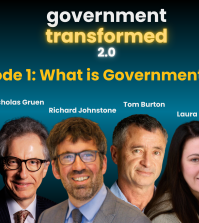
What happened next: In a new episode of Government Transformed, Siobhan Benita speaks to Aaron Snow, faculty fellow at Georgetown University in the Beeck Center for Social Impact and Innovation, about what it means for governments to achieve digital transformation with public good at the core – including his work helping turn healthcare.gov around and beyond. Snow has been named one of the world’s 20 most influential people in digital government. In this interview, he recounts his leadership journey.
Let it Snow: Starting as a Presidential Innovation Fellow in 2012, Snow became one of the founding members of 18F, an organisation set up as a digital expertise arm of the General Services Administration (GSA) to transform public services across America after the problems with healthcare.gov.
Driving change: In this candid conversation, Snow shares his insight on what it is like to drive digital change across government, as well as the day when an organisational restructure moved 18F from a discrete operation into a much larger outfit – and what this meant for its work. On a practical level, Snow details the daunting challenges he and his colleagues faced, describing the experience as like having to “design a plane while building it, while flying it”.
How to protect innovation: He emphasises the need for leaders to foster and protect a strong, innovative team culture. He highlights the importance of having regular conversations with people at every level of an organisation so that each competing need, incentive and requirement is understood.
Transformation in Canada too: He also reflects on his time leading the Canadian Digital Service, and his work now as a fellow at the Beeck Center for Social Impact and Innovation at Georgetown University, where he divides his time between the Digital Service Network and the Intergovernmental Software Collaborative.
Listen to the episode in full:

New UK government overhauls digital departments

The new UK government has made a series of alterations to the structure of Whitehall, headlined by changes to the key digital and data agencies.
All change: Ministers have announced that the government’s three central digital agencies – the Government Digital Service (GDS), the Central Digital and Data Office (CDDO) and the Incubator for AI (i.AI) – will move from the Cabinet Office to the Department for Science, Innovation and Technology (DSIT).
‘Transforming public services’: The expansion of DSIT aims to enable it to meet the mission of “transforming public services and fuelling economic growth through science and technology”.
“Britain will not fully benefit from the social and economic potential of science and technology without government leading by example. So, DSIT is to become the centre for digital expertise and delivery in government, improving how the government and public services interact with citizens,” science secretary Peter Kyle said.
A new digital centre of government: According to the announcement, the expanded department will “drive forward the digital changes needed to overhaul the British public’s experience of interacting with the government”, with a focus on making government more personalised, convenient and timesaving. DSIT will also work closely with central government departments the Cabinet Office and the Treasury “to maximise the potential of digital, data and technology to deliver for the British public”.
One Login to end them all? Initiatives highlighted include the development of a single login to make it easier for people to quickly access the government services they need, and to improve data sharing across the public sector. The UK government is developing a One Login system to allow users to create a government account to access services online. It is already being used by 30 government services and more than 3.8 million people have so far proven their identity through the system, according to a parliamentary answer in March.
GDS gets new leadership too: The Government Digital Service’s new leadership has also been confirmed. Christine Bellamy, formerly the director of the government’s GOV.UK website project, has been named chief executive of GDS, taking over from Tom Read who left the position last month.
Embracing the opportunity: Bellamy said: “Millions of people use our products every week, and we remain committed to working across government and the wider public sector to deliver joined-up, proactive, secure digital services that are better for users and cheaper for the taxpayer.”
Find out more about the changes to Whitehall here
Learn more at Public Service Data Live: Bringing together public service leaders within 100 days of the new UK government, Public Service Data Live will explore the opportunities and possibilities of digital and data reform across government. Speakers include Craig Suckling, chief data officer of the UK government; Ming Tang, chief data and analytics officer, NHS England; and Jenny Brooker, chief data architect, Central Digital and Data Office.
More sessions announced: Sessions include how to use data to create more personal government, how digital credentials can help join up government services, and the next steps for government transformation. Find out more and register for the event on 19 September in London
Say what you see: how to visualise public sector data

An upcoming Global Government Forum training session will provide insight on how to get real value out of data in order to present insight in a compelling way to senior leaders and other stakeholders.
Addressing a challenge for civil servants: Getting insight from government data to present it in a way that can influence public sector stakeholders can be challenging as it requires assessing the needs and data literacy of your audience.
Evidence-based techniques: This training seminar – taking place on 22 October – will give you a repeatable framework for turning data insights into persuasive visual stories for slide decks, reports, dashboards and other formats. It will introduce simple and effective evidence-based design techniques that can be applied using the software you already have access to.
Influence decisions: This seminar is designed for civil servants and public sector staff who regularly need to present data internally and externally. By building these skills you will be able to influence stakeholders and drive decision-making.
Malta leads the way in EU e-government rankings again

Malta has been named the top digital government in the EU, maintaining the place at the top of the rankings it has held for the entirety of the current decade.
The benchmark: The benchmark report scores nations on their online public services across four dimensions – user centricity, transparency, key enablers, and cross-border services – with 14 underlying indicators.
Ten at the top: Estonia is second in the rankings, closely followed by Luxembourg and Iceland. The remainder of the top 10 is: Finland, Lithuania, Denmark, Netherlands, Latvia and Turkey, which is included in the rankings as one of 10 non-EU nations.
Above average: The other countries with a score above the European average are Austria, Sweden, Norway and Portugal.
Making progress: Compared to the previous year, significant progress was also made in a number of countries outside the top 10. Greece continued its upward trend, experiencing an eight-point increase for the second consecutive year, while Bulgaria, Cyprus, Poland, Slovenia, Sweden and Serbia were also among the countries that made most progress.
AccelerateGOV: the next steps for government transformation

AccelerateGOV takes place on 21 October in Ottawa, bringing together public service leaders from around the world to discuss how to make progress on digital transformation.
Latest speakers confirmed: The panel for the conference’s closing session – the next steps for government transformation – has been confirmed. The session will hear from: Paul N. Wagner, chief executive officer at the Canadian Digital Service; Scott Jones, president of Shared Services Canada; and Dominic Rochon, the deputy minister and chief information officer of Canada.
How to: The panel will discuss how to make transformation happen in government. It will explore the next steps in the Canadian government’s digital transformation plan, looking at how to reach the key milestones of technology deployment, coordination of internal and external delivery partners, and how to prioritise resources to drive reform.
Find out more and register to attend AccelerateGOV
Connected islands: Laying the foundations for digital transformation in the Caribbean

At Global Government Forum’s Caribbean Digital Summit, technology chiefs from 13 island administrations converged on Barbados to explore the challenges they face in the region’s unique digital environment.
Very different, but shared challenges: The Caribbean region contains a diverse 700 islands with very different histories and economies, populations and ecologies, and their administrations occupy every constitutional status from local council to sovereign state. Nonetheless, the Caribbean’s civil servants face a similar set of goals and challenges.
How to meet the challenges: Based on interviews that took place in advance with 10 national digital leaders from across the Caribbean, which were then further developed at the event, GGF has come up with 11 key findings to help guide and support digital transformation in the region.
The first article on Global Government Forum covered the initial takeaways. We will share the final six takeaways in next month’s newsletter.
1. The Caribbean benefits from a rare and valuable asset: Many political leaders are highly engaged and well-informed, with prime ministers and cabinet members often actively leading and defining the agenda.
2. The production of a digital strategy and plan should involve agreeing key milestones and departmental goals with civil service leaders, allocating accountabilities for delivery, and establishing ways to measure progress.
3. Central digital teams need the technical skills and the leverage required to catalyse progress on digital agendas, including proportionate use of tools such as spending controls, central mandates, deployable teams and dedicated funding streams.
4. Governments should prioritise the provision of digital ID systems as a key foundation of digital transformation, requiring departments to adopt shared or compatible platforms so that citizens can use a single digital ID system across government – and, ideally, across the region.
5. External funders must ensure that their processes and policies do not compromise nations’ ability to focus on their own digital priorities, to move at pace, or to respond to local needs and circumstances.
Read the article in full: Connected islands: Laying the foundations for digital transformation in the Caribbean.
Thanks again for reading this month’s newsletter. Please get in touch on email or X to share your thoughts on digital transformation in government.

About Richard Johnstone
Richard Johnstone is the executive editor of Global Government Forum, where he helps to produce editorial analysis and insight for the title’s audience of public servants around the world. Before joining GGF, he spent nearly five years at UK-based title Civil Service World, latterly as acting editor, and has worked in public policy journalism throughout his career.

Related Posts