From rewiring the state to making cross-sector collaboration work: GGF’s 2025 research highlights

Over the past year, Global Government Forum (GGF) published several high-profile reports, focused on topics such as government innovation, NHS digital transformation, and using data and technology to deliver government priorities.
Our studies seek to understand the challenges and opportunities facing senior civil servants and present practical solutions to help everyone move ahead. We use the findings to inform our events, training, content, and programmes of collaborative work to make them as useful as possible.
Here are a few of this year’s highlights:
Rewiring the state: Unlocking government transformation
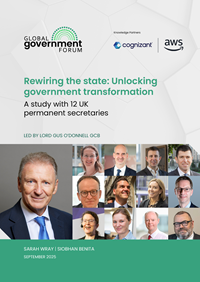
Our major study Rewiring the State: Unlocking Government Transformation report is unique in that it is based on interviews with 12 permanent secretaries from the UK’s major departments.
Led by former Cabinet secretary and head of the civil service Lord Gus O’Donnell, the study explores the key enablers to accelerating progress and the barriers that must be tackled if the government is to achieve its goal of “a complete rewiring of the British state” to deliver its priorities.
The report sets out four areas that government should focus on to create the conditions for reform, along with underpinning recommendations to support this. These are:
- Making digital a core part of government leadership and driving a culture of delivery
- Building transformational capability at every level, including among senior leaders
- Unlocking the full power of data and AI through reuse of proven tools, removing the blockers to data sharing, and smarter procurement
- Driving joined-up government through mechanisms that enable coordination and peer learning across departments
Departments featured include the Home Office, HMRC, the Department for Work and Pensions, the Ministry of Justice, HM Treasury, the Department for Education, the Department for Science, Innovation and Technology, the Department of Health and Social Care, the Department for Business and Trade, the Department for Energy Security and Net Zero, the Ministry of Defence, and the Foreign, Commonwealth and Development Office.
A fresh mandate for digital leadership in the NHS
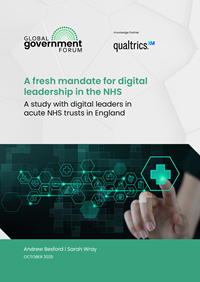
Our first health-focused study – titled A fresh mandate for digital leadership in the NHS – reveals the barriers that must be tackled if the NHS is to achieve the ‘analogue to digital’ shift set out in the 10 Year Health Plan and deliver its mission of a health service fit for the future.
The report, which was led by Andrew Besford, pinpoints four key reasons why digital progress stalls and four corresponding practical steps that could help move the system ahead.
Andrew led the creation of the 2017 UK Government Transformation Strategy as deputy director at the Government Digital Service. Since 2019 he has been a non-executive director and chair of the digital committee at Northumbria Healthcare NHS Foundation Trust and has also taken up the same role at Gateshead Health NHS Foundation Trust.
Based on interviews with chief digital and information officers, key recommendations include:
- Update financial mechanisms for the digital era: move from one-off capital handouts to predictable, devolved multi-year funding with light-touch guardrails, ongoing revenue support, and incentives for blueprint reuse and regional sharing.
- Prioritise digital as a strategic profession: build and retain digital, data and cyber skills on a par with other NHS professions, ensure boards have the expertise to support progress, and empower digital teams at every level to transform care pathways.
- Tackle fragmentation through standards, procurement and co-design: make open standards and interoperability mandatory, publish APIs and architecture guides, use procurement to drive value and innovation, and co-design central tools with trusts.
- Reset the digital centre: create a smaller, sharper national digital function focused on standards, shared services, and investment oversight, balancing trust and autonomy with firm guardrails so the whole system advances together.
At a launch event in Newcastle-upon-Tyne, Sir Jim Mackey, chief executive of NHS England, welcomed the report, calling it “grounded”and “very honest”.
“There’s a lot of good reflections there from colleagues in the service about where we need to go next,” he said.
Delivering economic growth in partnership
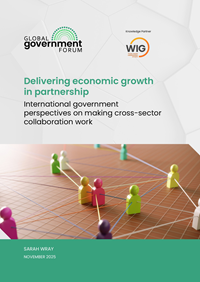
Addressing another major priority area for governments around the world, GGF’s research also explored economic growth.
Our Delivering Economic Growth in Partnership study confirms that success depends on cross-sector collaboration.
As one interviewee for the study put it: “I would say that we cannot survive in a future without very deep cross-sectoral cooperation between different kinds of partners.”
“The world is so complex today,” another explained. “We definitely need different kinds of ideas and opinions to take into consideration when we make decisions.”
The study identifies the critical factors that enable cross-sector partnerships between government, business, academia, and civil society to deliver real economic impact.
Based on interviews with government leaders in Australia, Canada, Estonia, Finland, France and Singapore, the research details how to make these collaborations succeed and avoid common pitfalls.
The report identifies success factors, including:
- Defining and agreeing the shared problem early, so that all partners are working towards the same goal
- Embedding trust and transparency through clear governance, with roles and accountabilities visible to all
- Investing in people and resources to make collaboration credible and sustainable
- Measuring progress jointly, using data and risk monitoring to adapt quickly when challenges emerge
Empowering public servants to make confident, informed decisions with data and AI

As data and AI become more embedded in government organisations, we looked at how to use these tools to effectively inform decision-making.
Our research – Empowering public servants to make confident, informed decisions with data and AI – revealed that while eight in 10 civil servants agree that better use of data would help to achieve a range of outcomes in their organisations, there is some way to go before the majority have access to the data they need and can use it consistently to inform decisions.
The survey of over 600 civil and public servants worldwide also found that while the vast majority of respondents (81%) see either some or great potential in using artificial intelligence to improve decision-making in government, the more advanced capabilities of AI tools remain largely untapped.
The report details the extent to which civil servants are using data in their work; identifies the obstacles blocking data-driven decision-making; and outlines what needs to be done to enable more comprehensive use of data and AI in government.
It sets out the potential of data and AI to meet the crucial government mission of boosting efficiency and productivity at a time of increasing demands, and includes examples and use cases from the UK, Ireland, Australia, Canada, Singapore, the US, and Nigeria.
New strategies for evolving public sector fraud threats: Fighting AI with AI

With public sector fraud increasing in frequency, intensity and complexity, we looked at the key approaches that governments around the world can use to tackle the evolving fraud threats they face.
All survey respondents were experiencing some form of fraud and expected to see an increase in at least one type of fraud over the next five years. Further, 96% said that fraud has either some or a great impact on trust in government, and 59% said that maintaining public trust is the main reason to prioritise fighting fraud, followed by protecting an organisation’s reputation and ensuring regulatory compliance.
The New Strategies for Evolving Public Sector Fraud Threats report also examined the growing role of AI – both in increasing the threat public sector organisations face and in how they can use the technology to respond. It features examples and expert insight from public servants involved in tackling fraud
Creating the conditions for innovation in government
To coincide with our flagship Innovation conference in March 2025, we asked civil servants about the enablers for innovation.
Support from leaders, a culture of open communication and risk-taking, skills like adaptability, and access to the right tools and data emerged as the key foundations.
Leadership support stood out as the most critical factor, with three-quarters viewing it as essential – much more so than any other factor. Factors following closely behind were a culture that embraces failure and learning (58%), and access to modern technology and tools (47%).
On creating an innovation culture specifically, respondents ranked open communication and idea sharing as the top factor for success, with 94% saying it is essential or very important. Following this were willingness to take risks and empowerment of employees to make decisions, with almost half seeing these as essential.
We also asked about skills, technology, and more, and the summary report features quotes and examples gleaned from throughout the Innovation conference.
What’s next
We have several new studies coming up in the new year covering topics including the future of the finance ministry, bolstering digital capability, and civil servants’ views on AI.
To find out more about our research programme or to suggest topics, contact me at [email protected]
View all GGF’s research reports
Visit GGF’s research report page to view all of these reports, and more, produced by Global Government Forum and our partners and designed to help senior public officials both to improve their skills and expertise, and to develop their organisations’ capabilities.

About Sarah Wray
Sarah has over 15 years’ experience as a journalist with a specialism in the public sector and topics such as digitalisation and climate action. Sarah was formerly the editor of Cities Today and Smart Cities World, as well as a specialist video-based publication in the aerospace sector. She has also written for publications including Smart Cities Dive, Mobile Europe, Mobile World Live and Computer Weekly.

Related Posts