The wrong kind of inheritance: how to replace legacy technology in government

In many countries, digital leaders can’t move forwards until they’ve first looked backwards – finding ways to handle an awkward legacy of outdated, inflexible technology systems. At the GovernmentDX summit in Washington DC, top IT chiefs explored how to transition away from an unwanted inheritance
“Technology modernisation is not a destination; it’s an ongoing journey,” said Laura Gerhardt, director of technology modernization and data in the US Office of Management and Budget. Addressing 40 senior digital leaders from US departments and overseas governments at GovernmentDX in Washington DC, Gerhardt was tackling one of the thorniest topics in public sector IT in a session entitled: ‘The barriers to overhauling legacy technology in government – and how they can be overcome’.
Global Government Forum’s public service digital conference GovernmentDX – now renamed Government Service Delivery, and scheduled for 13-14 May 2025 – includes a series of private roundtables for top digital leaders, providing a safe space for candid discussions on the challenges they face and the routes to success. Speaking at the inaugural event in the session on legacy, participants were particularly candid: replacing an old system is often far more difficult than creating a brand new service, and the cumbersome, static systems built by previous generations of IT leaders have proved an awkward inheritance for today’s digital chiefs.

As one participant commented: “Technology is never finished – there are always going to be emerging threats, new customer requirements, new capabilities that need to be integrated into existing solutions.” But this simple truth has not always been recognised.
“When we built those applications, we really did think that we were building them once and they were going to run forever,” commented Greg Gershman, co-founder and CEO of digital services provider Ad Hoc (pictured speaking). In time, however, circumstances changed – and inflexible, monolithic IT systems proved unable to adapt to public servants’ evolving needs.
How not to do it
Another senior digital leader related a “horror story” neatly illustrating the flaws in how IT professionals used to build technology systems. Twenty years ago, he recalled, one major government agency commissioned a consultancy to write “the mother of all requirements documents”, then contracted a big IT firm to construct its new system. “The cost to build the thing went from 200 million up to nearly 900 million, and it took nearly seven years,” he explained – but when they revealed it to frontline staff, the response was that it didn’t meet the way they worked at all. As a result, he explained, “staff reverted to paper and spreadsheets, and they hired a bunch of people to key those spreadsheets into the system every evening. Not only did they waste a billion dollars, but they also created a massive workflow bottleneck.”

Such projects have lumbered today’s technologists with IT systems that are increasingly unable to handle the challenges facing them – from cyber threats and meeting the accessibility requirements of an ageing population to sudden spikes in demand. Tim Paydos, vice president for global public sector mission solutions at event knowledge partner ServiceNow (left), gave one example of the consequences: “During the early days of COVID, one US state saw a 950% increase in calls to their unemployment agency in one week, and the system crashed,” he recalled. “The call centre could not intake requests for financial relief fast enough, and the back-end ‘cheque-cutting’ system did not have the agility to meet this new demand.”
“We don’t know what the next big thing is going to be, but there’s a sense of foreboding that these ‘black swan’ events are happening more often and having greater impact – whether it’s supply chain disruption, cyber attacks, regional conflicts, climate events, pandemics,” he said. “Whatever it is, the government needs the agility and flexibility to react with speed and restore citizens’ trust.”
Government Service Delivery is the new name for GovernmentDX and will be taking place in the Walter E Washington Convention Center, Washington DC on May 13-14, 2025. Find out more about the event and register your interest here.
Examples of success
Against this backdrop, there is a push to replace ageing mainframes with adaptable, cloud-based digital services – transforming services along the way to realise the full potential of today’s technologies. As an example of what is possible, Paydos cited one large Californian county where public servants built a new platform for 11 public agencies working on issues related to homelessness.
Previously, homeless people had to interact with up to 11 different professionals – but with the new system in place, staff from any one of those agencies could help them to access services from all 11. “It was a force multiplier,” commented Paydos. “Within six months, they had dropped homelessness by 30%, and the folks leaving temporary housing to go back to the streets dropped by 80%.”
To build trust in the new system, Paydos explained, agencies were allowed to retain control of their own data – feeding information to individual caseworkers as required – and app developers demonstrated value quickly with a basic service that people immediately found helpful. “It took 12 weeks from the initial workshop to having something on an iPad for people to use in the field,” he said. “It began to work – and as it began to work, people began to believe and started building trust. Then they started to expand the use cases.”
Obstacles in your way
There are always challenges to overcome when overhauling service provision in this way – often including public sector procurement and finance processes. “Your governance assumes that you’re building a submarine, not software, so it expects you to have absolute certainty at the point of least knowledge: at the beginning of the programme,” commented one digital leader. “And if you do get the funding, it’s a large capital investment on the assumption that once you’ve built the thing, you’ll never need to support it afterwards.”
Legislation can also get in the way, noted another digital chief – tightly defining processes in ways that constrain how services can be delivered. Ironically, the sheer amount of work involved in maintaining legacy systems can also limit the time and resources available to devise a better solution. “It eats up all your discretionary time and your people,” said one participant. “We have amazing people in our agencies who are spending 80% of their time feeding and watering these awful monolithic systems rather than doing the transformation.”
The need to pare down the accumulated legislation that holds back transformation was also flagged as a key recommendation in Global Government Forum’s From Lagging to Leading: The Opportunity for a Breakthrough in U.S. Government Digital Service Delivery study, based on interviews with 13 members of the US federal government’s CIO Council. Read the report in full here.
Getting from A to B
Nonetheless, leaders attending GovernmentDX had found ways to replace these outdated systems with modern digital services. One representative championed the “strangler fig” approach advocated by digital expert Martin Fowler. This involves incrementally building up new data feeds and services around the legacy system, until eventually it has been rendered redundant and can be retired.
“You don’t try to change the monolith: you build an API, and that allows you to build microservices to replace individual components,” they said. In the case of one ageing legacy system, they recalled, managers had recruited frontline staff “and taught them how to be product managers, then we got them to prioritise. The [legacy] system did 70 or 80 different things, so we picked four or five of them, and with agile teams we built modern microservices; in the background, we switched off those bits”.
As a result the legacy system was slowly eclipsed, while frontline staff “were getting these amazing digital services designed around how they worked, and they didn’t have to interact with the back-end system any more”.
While the previous generation of IT professionals planned ‘big bang’ solutions, then built systems that were out of date before they were up and running, today’s digital leaders feel their way forward is to build solutions flexible enough to adapt to changing needs. “That’s our playbook,” the digital leader advised. “Iterate your way out of the problem.”
This incremental approach has the advantage of building people’s confidence gradually through demonstrable results. “Get enough funding for a small team, build something of value, and then show it to the people who control the money,” they concluded. That fitted with Paydos’s approach. “Find five or ten use cases: lightweight, low trauma solutions to specific pain points,” he said. “Get them delivered, get value, build skills and competence, build trust in your organisation. Then go to the next use case. While what we’re talking about is transformational and revolutionary, the path to value is very much iterative and evolutionary.”

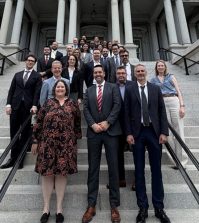
As the discussion came to a close, Lauren Bracey Scheidt, assistant commissioner of the Technology Transformation Services Office of Solutions in the US General Services Administration, (pictured centre with Scott Jones, president, Shared Services Canada, left, and Larry Bafundo, deputy executive director and acting executive director, Technology Modernization Fund, US General Services Administration, right) neatly summarised the challenge facing governments around the world. “What we do in a crisis is what we do all the time, just louder and with more urgency,” she said. “So if the processes and structures that we build while things are calm and safe can only move slowly, that’s what we’ll do in a crisis – and we won’t get the outcomes we need.”
The invitation-only meeting at Government Service Delivery is a private event, providing a safe space at which civil service leaders can debate the challenges they face in common. We publish these reports to share some of their thinking with our readers. Note that to ensure that participants feel able to speak freely at the meeting, we check before publication that they are content to be quoted.
The 2024 meeting will be covered in four reports, covering the four sessions:
· Seamless by design: the barriers to overhauling legacy technology in government – and how they can be overcome
· A problem shared: how governments are tackling cyber threats – Global Government Forum
· AI in government – how, where and why?
· What you need when you need it: the power of user-centred design

About Matt Ross
Matt is Global Government Forum's Contributing Editor, providing direction and support on topics, products and audience interests across GGF’s editorial, events and research operations. He has been a journalist and editor since 1995, beginning in motoring and travel journalism – and combining the two in a 30-month, 30-country 4x4 expedition funded by magazine photo-journalism. Between 2002 and 2008 he was Features Editor of Haymarket news magazine Regeneration & Renewal, covering urban regeneration, economic growth and community development; and from 2008 to 2014 he was the Editor of UK magazine and website Civil Service World, then Editorial Director for Public Sector – both at political publishing house Dods. He has also worked as Director of Communications at think tank the Institute for Government.



Related Posts