New Global Government Forum study calls for a ‘step-change’ to unlock NHS digital transformation

A new study carried out with digital leaders in NHS trusts in England has revealed the barriers that must be tackled if the NHS is to achieve the ‘analogue to digital’ shift set out in the 10 Year Health Plan and deliver its mission of a health service fit for the future.
The report comes at a time of great change and opportunity for the NHS, and the government has made clear that digital is at the heart of reform.
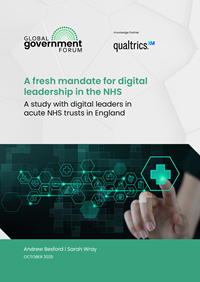
Based on interviews with chief digital and information officers (CDIOs), the research highlights the systemic enablers needed to deliver NHS digital transformation – from prioritising digital as a strategic profession to resetting the role of the digital centre.
The report – A Fresh Mandate for Digital Leadership in the NHS – published by Global Government Forum, pinpoints four key reasons why digital progress stalls and four corresponding practical steps that could help move the system ahead.
It finds that ambition exists across digital teams in the NHS, but they are often diverted from forward-looking work to deal with operational issues, and change is frequently confined to cautious increments.
Andrew Besford, report author, commented: “Considerable commitment, hard work and digital progress is evident but it is clear that the NHS as a whole has not made the expected progress on digital transformation, and that previous investments have not delivered fully on national ambitions.
“This calls for a step-change: treating digital as mission-critical to safe, high-quality care and giving leaders at a national, regional and local level the mandate and support to deliver it.”
Download the report: A Fresh Mandate for Digital Leadership in the NHS
Recommendations
Key recommendations in the report, based on the reflections of CDIOs, include:
- Update financial mechanisms for the digital era: move from one-off capital handouts to predictable, devolved multi-year funding with light-touch guardrails, ongoing revenue support, and incentives for blueprint reuse and regional sharing.
- Prioritise digital as a strategic profession: build and retain digital, data and cyber skills on a par with other NHS professions, ensure boards have the expertise to support progress, and empower digital teams at every level to transform care pathways.
- Tackle fragmentation through standards, procurement and co-design: make open standards and interoperability mandatory, publish APIs and architecture guides, use procurement to drive value and innovation, and co-design central tools with trusts.
- Reset the digital centre: create a smaller, sharper national digital function focused on standards, shared services, and investment oversight, balancing trust and autonomy with firm guardrails so the whole system advances together.
Besford led the creation of the 2017 UK Government Transformation Strategy as deputy director at the Government Digital Service. Since 2019 he has been a non-executive director and chair of the digital committee at Northumbria Healthcare NHS Foundation Trust and recently took up the same role at Gateshead Health NHS Foundation Trust.
He added: “This is not digital for digital’s sake. Done well, the ‘analogue to digital’ shift should mean shorter waits, safer care, better staff experience and higher productivity, which are all vital for restoring public confidence and sustaining the NHS for the next generation.”
The report was supported by knowledge partner Qualtrics.
Adrienne Boissy, MD MA, Chief Medical Officer, Qualtrics, said: “As technology and digital solutions work to meaningfully improve how we deliver care at scale, the opportunity is tremendous. The magic is in the how: amplifying relationships, listening to emotions at all touchpoints, and making the lives of patients and clinicians easier.”
Boissy is also Staff Neurologist and former Chief Experience Officer at Cleveland Clinic, and Clinical Professor of Neurology at Case Western Reserve University.
“Technology must amplify our humanity. I believe it can. Because whether in a bustling emergency department or trying to access care through an app, human beings seek the same fundamental experiences: to be respected, included, valued, and truly heard,” she said.

About Sarah Wray
Sarah has over 15 years’ experience as a journalist with a specialism in the public sector and topics such as digitalisation and climate action. Sarah was formerly the editor of Cities Today and Smart Cities World, as well as a specialist video-based publication in the aerospace sector. She has also written for publications including Smart Cities Dive, Mobile Europe, Mobile World Live and Computer Weekly.

Related Posts